
Anthropogenic iron impact on the surface productivity in the Pacific Transition Zone

Industrial emissions now add to the natural iron (Fe) supply, but ecosystem impacts from anthropogenic iron input have not yet been demonstrated. Hawco and his colleagues (2025, see reference below) tackled this issue by combining iron concentration and isotopic composition measurements across 4 North Pacific cruises over 4 years, including GEOTRACES section GP15. Light Fe isotopic composition demonstrate that industrial activities have increased the supply of iron to the North Pacific Transition Zone, a highly productive region between 30 – 45 °N, which the authors estimate to be 39 ± 9 % of the annual ocean iron budget in the surface mixed layer. Authors also show that the Transition Zone ecosystem is co-limited by both iron and nitrogen, meaning that the excess of iron accelerates the seasonal drawdown of nitrate delivered by winter mixing. This effect can explain regional trends in satellite ocean color, which show a shorter spring bloom period and an earlier arrival of oligotrophic conditions in summer. Anthropogenic iron supply may act in concert with climate change to shift ecosystem boundaries farther north.
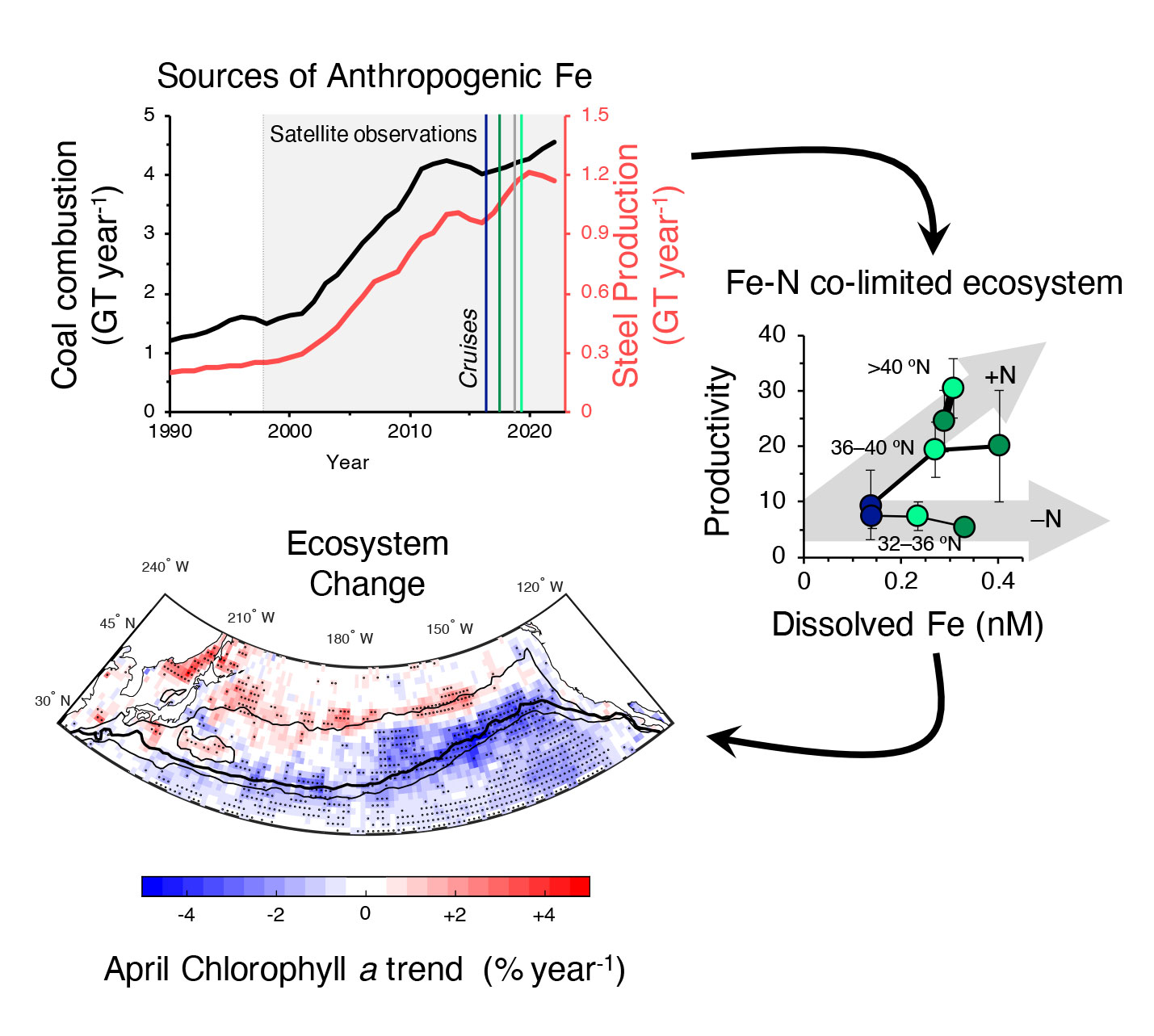
Figure: Impacts of anthropogenic iron to an Fe co-limited ocean. Top panel: Increasing coal combustion and steel production in East Asia, which are important sources of anthropogenic iron to the North Pacific. Right panel: Increasing net community production by both dissolved iron (dFe) and nitrogen (N) in the North Pacific transition zone indicates an Fe-N co-limited ecosystem. Lower panel: Trend in satellite-detected chlorophyll a in the North Pacific Transition Zone during the spring bloom period (April). Increasing chlorophyll (red) at ~40N is consistent with fertilization of an N-rich ecosystem by anthropogenic Fe. An intensified spring bloom leads to an earlier depletion of N reserves, driving a decrease in chlorophyll (blue) between 30-40N.

Reference:

Hawco, N. J., Conway, T. M., Coesel, S. N., Barone, B., Seelen, E. A., Yang, S.-C., Bundy, R. M., Pinedo-Gonzalez, P., Bian, X., Sieber, M., Lanning, N. T., Fitzsimmons, J. N., Foreman, R. K., König, D., Groussman, M. J., Allen, J. G., Juranek, L. W., White, A. E., Karl, D. M., Armbrust, E. V., & John, S. G. (2025). Anthropogenic iron alters the spring phytoplankton bloom in the North Pacific transition zone. Proceedings of the National Academy of Sciences122. doi:10.1073/pnas.2418201122

Latest highlights

Mercury content and isotopes in bird’s guano: a window to reconstruct past climates

By analysing peat cores, Chuxian Li and her colleagues have shown how populations of nesting seabirds have fluctuated on a sub-Antarctic Island over the last 8,000 years.

Contraction of North Atlantic Deep Water during glacial times: a paradigm called into question

Blaser and co-authors propose a new distribution of deep-water masses in the Atlantic Ocean during the Last Glacial Maximum and the Heinrich Stadial..

Authigenic radiogenic neodymium isotope composition traces millennial-scale overturning circulation variability in the Arabian Sea

The neodymium isotopic signature of the sediment authigenic fraction is, a priori, a valuable proxy for reconstructing deep-water mass trajectories…

Magmatic activity at the Carlsberg Ridge in the Indian Ocean triggered by glacial sea-level variation

De and colleagues provide a high-resolution record of magmatic input and associated hydrothermal activity over the past 49 kyr from a core recovered from a magmatic segment of the slow-spreading Carlsberg Ridge in the Indian Ocean.

Rechercher