
East-West contrasting fate and anthropogenic inputs for dissolved trace metals in the Subarctic Pacific Ocean

Chan and co-authors (2025, see reference below) report the full-depth distribution of dissolved (d) nickel (Ni), copper (Cu), zinc (Zn), and cadmium (Cd) in the North Pacific Ocean. These trace metals (TM) are bioactive and known as «nutrient-type elements». However, this study highlights contrasting east–west differences in their distribution in the subarctic Pacific Ocean. While the solid linear relationship between dCd and phosphate (PO4) confirms that both nutrients are tight by a concurrent influence of ocean circulation and biogeochemical cycling, other TM shows variable influences of scavenging, remineralization, bottom or margin inputs and transport. The ratio between dTM and PO4 proves that the effect of scavenging is increasing in the order of Cd < Ni < Zn < Cu < Fe, processes leading to a distinct east–west distributions in the upper water. The depletion of dZn is severe in the eastern subarctic Pacific, while the calculation of Enrichment Factors (EF) reveals high anthropogenic atmospheric input of trace in the subarctic Pacific under the westerly wind zone.
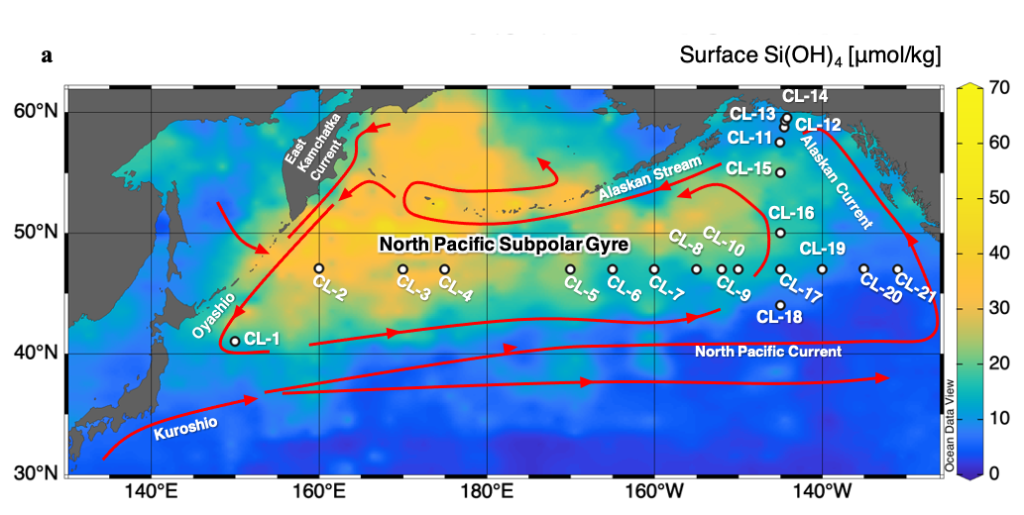
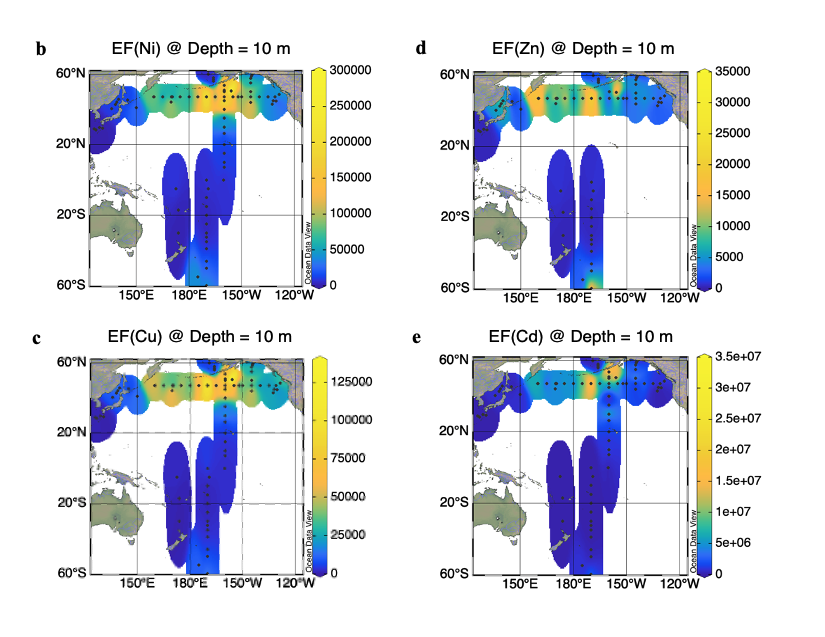
Figure: (a) Map of the sampling stations during the R/V Hakuho Maru KH-17-3 cruise. Red arrows represent surface currents. Annually averaged surface silicate concentration data in 2018 were adopted from the World Ocean Atlas 2018. (b-e) Horizontal distributions of the enrichment factor EF(dTM) at 10 m depth in the Pacific Ocean and marginal seas.  Anthropogenic atmospheric input of trace metals is high in the subarctic Pacific under the westerly wind zone compared to the other regions in the Pacific Ocean.

Reference:

Chan, C.-Y., Zheng, L., & Sohrin, Y. (2025). The behaviour of nickel, copper, zinc, and cadmium in the subarctic Pacific Ocean: East–West differences. Journal of Oceanography. Access the paper:10.1007/s10872-025-00746-y

Latest highlights

Continuous record of the Antarctic Circumpolar Current latitude over the last glacial-interglacial cycles

The meridional positions of the oceanic fronts separating subtropical and Antarctic waters are key to constraining the mechanisms that drive the degassing of deeply-stored CO2 at the end of the glacial periods…

23 Million Years of iron sources reconstructed in the Northwest Pacific Ocean using iron isotopes in a ferromanganese crust

Using iron isotopes and elemental records, Chu and co-workers analysed an iron-manganese crust recovered from the Hongyan Seamount, and reconstructed the sources of dissolved Fe to the Northwest Pacific Ocean…

Variability of the past deep-water masses in the Arabian Sea over the last 41ka

Shukla and colleagues propose a high-resolution authigenic ƐNd record measured from a sediment core located in the eastern Arabian Sea…

Arctic outflows to Davis Strait and the Labrador Sea traced by radionuclide distributions

This study demonstrates that Arctic outflows through the Canadian Arctic Archipelago play a much more significant role than previously recognised.

Rechercher