
Are the mid oceanic ridges a source of radiogenic neodymium input?
An unexpected radiogenic value of neodymium (Nd) isotopic composition observed by Catherine Jeandel and colleagues in the Deep Pacific Water raises the question of the role of mid ocean ridges in modifying the oceanic Nd signature.
GEOTRACES researchers measured three vertical profiles of rare earth element (REE) concentrations and Nd isotopic compositions in the remote southeast Pacific Ocean. Close to the coast, Nd isotopic compositions were clearly more radiogenic than in the open ocean, suggesting that boundary exchange process is releasing lithogenic rare earth element from the volcanic Andes. A surprisingly radiogenic value was also observed at 2000m in the Upper Circumpolar Deep Water (UCDW) that commonly have low radiogenic values (εNd values around -6, see figure below). Exchange processes related to hydrothermal activity are suspected to produce this increase in the value of neodymium isotopic compositions in the vicinity of the East Pacific Rise. These results provide some guidance for higher resolution studies planned in this region by the international GEOTRACES programme.
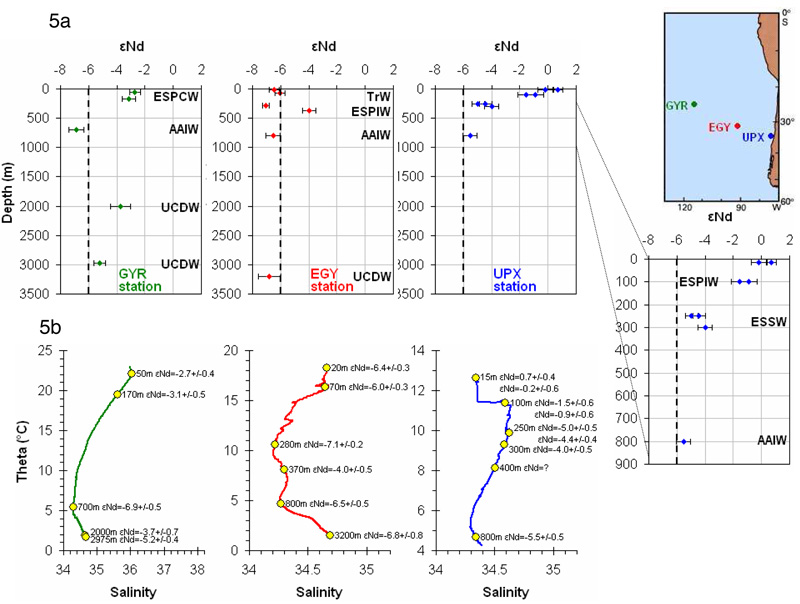
Figure: Vertical profiles of εNd values at the 3 stations. An extended scale for the upper layers of station UPX is proposed. The doted line marks the εNd value of -6. Acronyms recall the water mass names. The most striking features are 1) the radiogenic values along the Chilian coast, reflecting local inputs and 2) the relatively high value for UPCW at station GYR, which is suspected to reflect an hydrothermal influence. Click here to see the figure in high resolution. Source author’s manuscript.
Reference:
Jeandel, C., Delattre, H., Grenier, M., Pradoux, C., Lacan F. (2013) Rare Earth Concentrations and Nd isotopes reveal exchange processes along the East Pacific Rise, South East Pacific Ocean, Geochemistry, Geophysics, Geosystems 14, p. 328-341 DOI: 10.1029/2012GC004309 Click here to access the author’s manuscript.