
Surprise in the Gulf of Aqaba: intense dust inputs are not a source of trace metals to seawater!

Catching the impact of short-term environmental perturbations such as dust storms and sediment resuspension events on the oceanic water column is always a main challenge. Time Series Stations (TSS) are good tools to improve the temporal sampling resolution allowing the description of episodic natural events and their impact on the water column.

Benaltabet and his colleagues (2023, see reference below) present a 2-year time series of dissolved manganese, cobalt, nickel, copper, zinc, cadmium, and phosphate concentration profiles sampled at a daily resolution in the Gulf of Aqaba (GoA), Red Sea. The characteristics of this TSS is to provide a highly accessible deep oligotrophic water body, experiencing intensive atmospheric and resuspension events.

Their main results are that 1) upper water column trace metal inventories decrease with increasing dust loads. Aerosol-induced shifts peak ∼5–6 days after dust deposition and 2) dust storms and sediment resuspension events drive a decrease in trace metal (manganese, cobalt, nickel, copper and cadmium) concentrations.

These results are surprising and reflect a process of metal adsorption onto dust particles sinking in seawater (scavenging). These unique findings allow the authors to quantify the impacts of dust on seawater trace metal contents, and demonstrate that on the long term, dust is a source of metals to the oceans, but on shorter time scales, dust is also capable of removing metals from seawater.
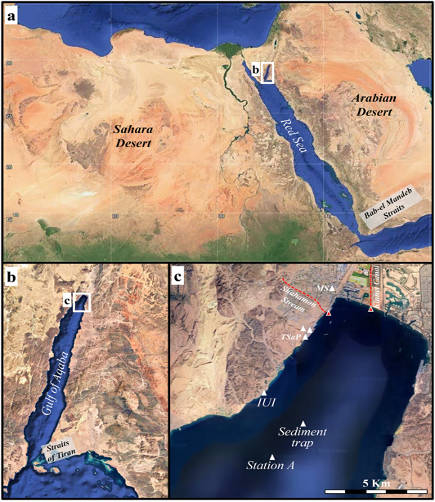
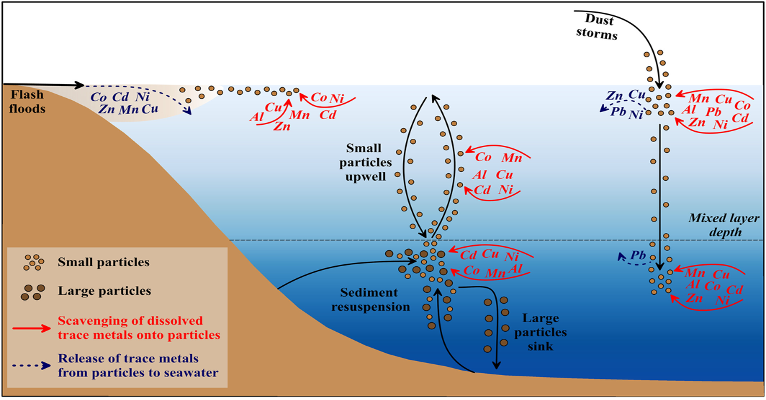
Figure 1: Location map. (a) The Red Sea and surrounding Saharan and Arabian Deserts. (b) The Gulf of Aqaba at the northern Red Sea. (c) Locations of the time series study site at Station A (∼700 m depth), sediment trap mooring, on-shore research station (IUI), total suspended atmospheric particles monitoring stations (TSaP), and meteorological station rain gauge (MS). The Shahamon Stream and Kinnet Canal and the corresponding seawater sampling locations are represented by broken red lines and triangles, respectively. Aerial footage from Google Earth. Figure adapted from Benaltabet et al. (2022).
Figure 2: Conceptual model summarizing the response of dissolved trace metals (TM) to perturbative events. Pb and Al dynamics were described by Benaltabet et al. (2020, 2022). Solid red arrows represent scavenging of dissolved TMs onto particles and broken blue arrows represent the dissolution of TMs from particles to surrounding waters. Dust storm-related settling aerosols induce substantial dissolved TM scavenging of all studied metals, both across the mixed layer and at depth. However, dust storms seldom lead to TM enrichment, which is associated with anthropogenic-sourced metals. Episodes of sediment resuspension promote scavenging of TMs at depth and across the upper water column, as small resuspended particles are upwelled to surface waters across the mixed layer. Flash floods bring significant enrichment in dissolved TMs at the coast. Concomitantly, flood particles carried along surface waters promote the scavenging removal of TMs at open waters.

References:

Benaltabet, T., Lapid, G., & Torfstein, A. (2023). Response of Dissolved Trace Metals to Dust Storms, Sediment Resuspension, and Flash Floods in Oligotrophic Oceans. Global Biogeochemical Cycles, 37. Access the paper:10.1029/2023gb007858

Benaltabet, T., Lapid, G., & Torfstein, A. (2022). Dissolved aluminium dynamics in response to dust storms, wet deposition, and sediment resuspension in the Gulf of Aqaba, northern Red Sea. Geochimica et Cosmochimica Acta, 335, 137–154. Access the paper: 10.1016/j.gca.2022.08.029

Benaltabet, T., Lapid, G., & Torfstein, A. (2020). Seawater Pb concentration and isotopic composition response to daily time scale dust storms in the Gulf of Aqaba, Red Sea. Marine Chemistry, 227, 103895. Access the paper: 10.1016/j.marchem.2020.103895


Latest highlights

Continuous record of the Antarctic Circumpolar Current latitude over the last glacial-interglacial cycles

The meridional positions of the oceanic fronts separating subtropical and Antarctic waters are key to constraining the mechanisms that drive the degassing of deeply-stored CO2 at the end of the glacial periods…

23 Million Years of iron sources reconstructed in the Northwest Pacific Ocean using iron isotopes in a ferromanganese crust

Using iron isotopes and elemental records, Chu and co-workers analysed an iron-manganese crust recovered from the Hongyan Seamount, and reconstructed the sources of dissolved Fe to the Northwest Pacific Ocean…

Variability of the past deep-water masses in the Arabian Sea over the last 41ka

Shukla and colleagues propose a high-resolution authigenic ƐNd record measured from a sediment core located in the eastern Arabian Sea…

Arctic outflows to Davis Strait and the Labrador Sea traced by radionuclide distributions

This study demonstrates that Arctic outflows through the Canadian Arctic Archipelago play a much more significant role than previously recognised.

Rechercher