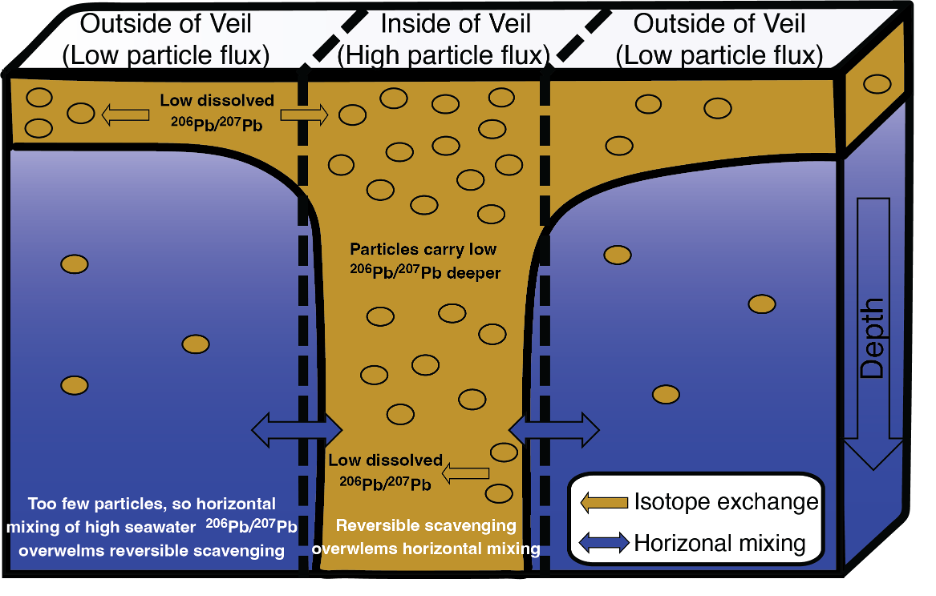
This work follows the penetration of anthropogenic lead (traced using its isotopic signatures) into the pristine deep Pacific Ocean. Lanning and his co-authors (2023, see reference below) demonstrate that reversible scavenging is the main “transportation agent” of dissolved lead to the abysses. Indeed, surface to depth transport of contaminant lead is favoured by the occurrence of “particle veils” in the North and equatorial Pacific: these elevated particle concentrations provide a unique opportunity to further understand the cycling of lead in the marine environment and the importance of reversible scavenging in the distribution of dissolved lead and its isotopes.
Figure: Schematic of the role that reversible scavenging plays in lead (Pb) cycling inside and outside of particle-rich veils such as at the equator and near the subarctic-subtropical transition zone. Blue background colour represents ambient seawater carrying high seawater dissolved 206Pb/207Pb isotopic signals (206Pb/207Pb = 1.19 to 1.21) while the brown background colour represents low, anthropogenic dissolved 206Pb/207Pb isotope signals (206Pb/207Pb = 1.155 to 1.17) that are vertically transported throughout the entire Pacific water column. Low 206Pb/207Pb signals will adsorb to particles within the upper Pacific Ocean across the GEOTRACES GP15 transect. As the particles sink through the water column, the low 206Pb/207Pb signals will reversibly scavenge and desorb from the particles influencing seawater 206Pb/207Pb signatures. However, only in veil regions where particle flux is high enough, will reversible scavenging of these low 206Pb/207Pb signals off sinking particles overwhelm the influence of horizontal mixing carrying high 206Pb/207Pb signals into the deep water column resulting in a visible isotopic fingerprint throughout the entire water column.
Reference:
Lanning, N. T., Jiang, S., Amaral, V. J., Mateos, K., Steffen, J. M., Lam, P. J., Boyle, E. A., & Fitzsimmons, J. N. (2023). Isotopes illustrate vertical transport of anthropogenic Pb by reversible scavenging within Pacific Ocean particle veils. Proceedings of the National Academy of Sciences, 120. Access the paper:10.1073/pnas.2219688120
Rechercher
We use cookies to guarantee you the best experience on our site, and to make statistics of attendance (Google Analytics). If you continue to use this site we will assume that you are happy with it.