
Neural network as tools to replace oceanic data deficiencies
The importance of the cycle and speciation of nitrate and its isotopes (δ15N) in the ocean does not have to be demonstrated anymore. In an attempt to overcome the difficulty to compare the results of N/δ15N cycle models to a sparse set of data, Rafter and co-workers propose an original approach, based on artificial intelligence (AI) methods.
They use a compilation of 12,277 published δ15N measurements together with climatological maps of physical and biogeochemical tracers to create a surface to-seafloor map of δ15N using an ensemble of artificial neural networks (EANN). In other words, they train the seawater parameters to deduce a δ15N value at a given location and depth taking into accounts the climatological values. The strong correlation (R2 > 0.87) and small mean difference (< 0:05 ‰) between EANN-estimated and observed nitrate δ15N indicate that the EANN provides a good estimate of climatological nitrate δ15N without a significant bias. This climatology reveals large-scale spatial patterns in nitrate δ15N and allows the quantification of regional and basin-average oceanic values of nitrate δ15N. This work demonstrates how AI tools could help to address the unavoidable deficiency of data inherent to oceanic studies, keeping in mind that they require ab initio reasonable data coverage and mostly a good understanding of the parameter fate.
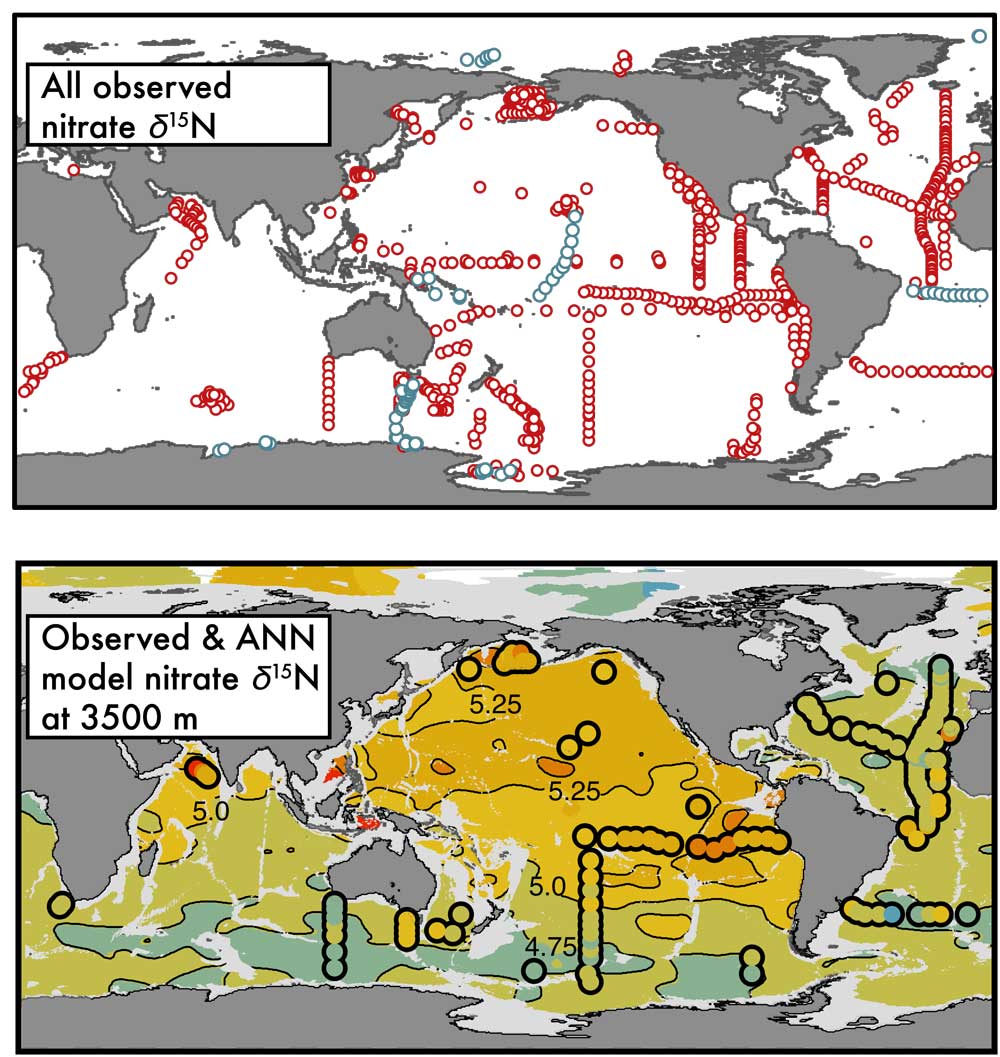
Figure: (Top) Available nitrate δ15N (N isotopic composition) measurements at the time of publication. (Bottom) View of nitrate δ15N at 3500 m from two perspectives: the observed value (circles) and the model value (the contours).
Reference:
Rafter, P. A., Bagnell, A., Marconi, D., & DeVries, T. (2019). Global trends in marine nitrate N isotopes from observations and a neural network-based climatology. Biogeosciences, 16(13), 2617–2633. https://doi.org/10.5194/bg-16-2617-2019