
Greenland’s floating ice tongues, sources of dissolved lead to the Arctic
Glacial freshwater discharge is a source of trace elements to shelf waters. Approximately half of freshwater discharge from the Greenland and Antarctic Ice Sheets enters the marine environment subsurface beneath large floating ice tongues or ice shelves, yet due to the obvious logistical difficulties in working adjacent to ice shelves, few studies have investigated the factors constraining subglacial trace metal export to adjacent shelf regions. Furthermore, there is increasing evidence that many elements of interest (e.g. iron, manganese) in these ice-proximal environments are mainly supplied indirectly from sedimentary processes rather than directly via meltwater.
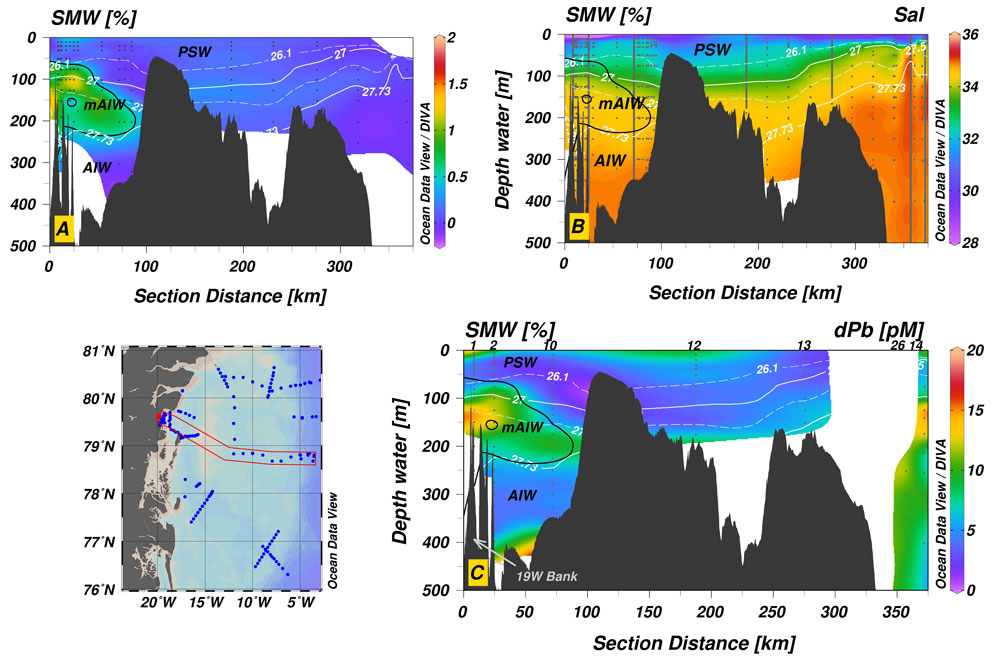
Using helium and neon as tracers for subglacial meltwater, Krisch and colleagues (2022, see reference below) found that subglacial discharge from the cavity underneath Nioghalvfjerdsbrae, Greenland’s largest floating ice tongue, is a source of dissolved lead (Pb) to the Northeast (NE) Greenland Shelf, currently around 2.2 ± 1.4 Mg per year and comparable to that of smaller Arctic rivers. Results suggest freshwater addition beneath the floating ice tongue is only a minor source of dissolved Pb, with the dominant fraction (~90%) likely derived from glacial bedrock and cavity sediments. Most strikingly, whilst helium/neon trace a plume of dissolved Pb, they do not show such clear evidence for a direct source of other dissolved trace metals. The extended residence time of waters underneath the floating ice tongue of several months to a year results in a near-steady state between addition of dissolved lead and removal of the non-stabilized fraction. This suggests that subglacial dissolved lead export may scale with the rate of shelf-cavity water exchange. In future, the retreat of the marine-terminus, as observed with the disintegration of Spalte Glacier in July 2020, and more rapid discharge of cavity waters has the potential to increase dPb supply to coastal surface waters in NE Greenland which may be a concern for future fisheries.
References:
S Krisch, O Huhn, A Al-Hashem, MJ Hopwood, P Lodeiro, EP Achterberg: Quantifying ice-sheet derived lead (Pb) fluxes to the ocean; a case study at Nioghalvfjerdsbræ. Geophysical Research Letters, vol. 49(21), e2022GL100296, 2022. Access the paper: https://agupubs.onlinelibrary.wiley.com/doi/10.1029/2022GL100296
O Huhn, M Rhein, T Kanzow, J Schaffer, J Sültenfuß: Submarine Meltwater From Nioghalvfjerdsbræ (79 North Glacier), Northeast Greenland. Journal of Geophysical Research: Oceans, vol. 126(7), e2021JC017224, 2021. Access the paper: https://doi.org/10.1029/2021JC017224