
Debate on the dissolved nickel bioavailibility in surface waters

John and co-authors (2022, see reference below) tackle one of the known paradoxes regarding trace metal cycles in the ocean: the dissolved nickel (Ni) leftover systematically observed in surface waters while Ni is a limiting factor for the phytoplankton development. Their strategy follows a double approach: test of the lability and bioavailability of Ni in the surface ocean using trace metal extraction from surface waters using chelating resins and controlled phytoplankton cultures, respectively; test of what controls the fluxes of Ni into the deeper ocean, with regards to the phosphate export and remineralization. These two main processes that govern the Ni cycles are thus confronted to field and experimental data using 7 different sensitivity tests with the AWSOME-OCIM model. In the end, the authors suggest that slow depletion of Ni relative to macronutrients in upwelling regions can explain the residual Ni pool. They also propose that slower regeneration of Ni compared with macronutrients explains the strong Ni enrichment in deep waters.
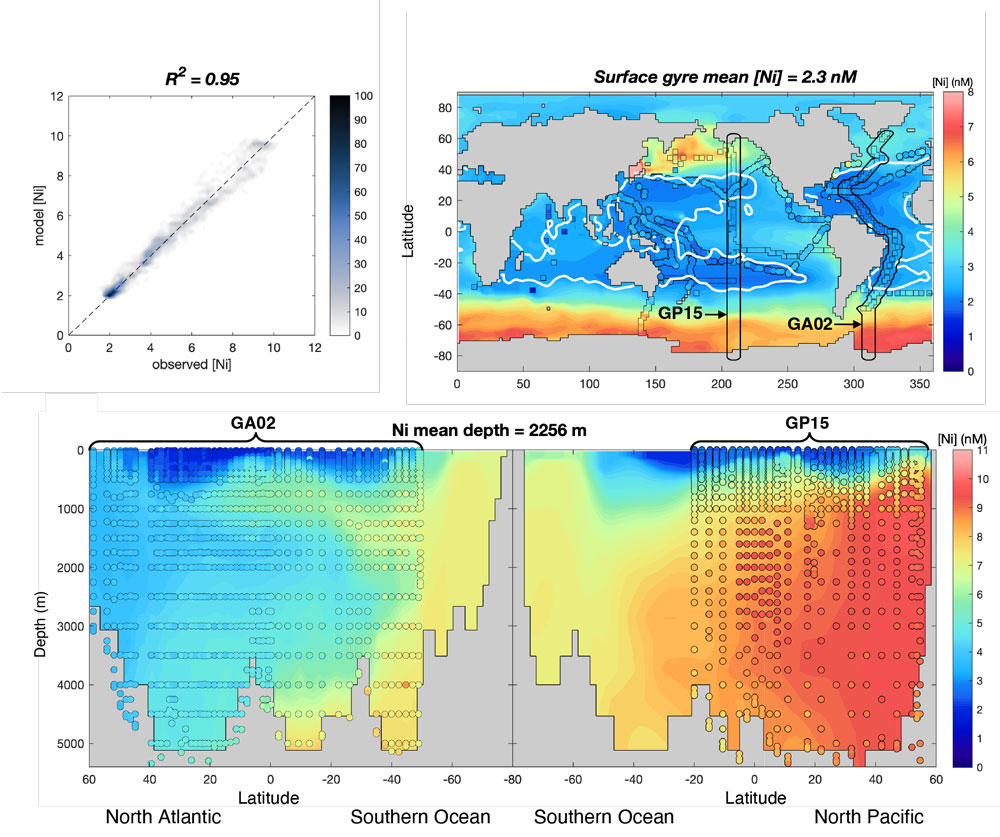
Figure: Modeled nickel concentrations match observations throughout the global oceans, with an R-squared of 0.95, where background fields represent model output and circles represent observations. Model nickel concentrations in the surface ocean are never depleted much below 2 nM, despite all of the Ni being bioavailable in the model. The model also reproduces the relatively deep regeneration of Ni compared to macronutrients N and P.

Reference:

John, S. G., Kelly, R. L., Bian, X., Fu, F., Smith, M. I., Lanning, N. T., Liang, H., Pasquier, B., Seelen, E. A., Holzer, M., Wasylenki, L., Conway, T. M., Fitzsimmons, J. N., Hutchins, D. A., & Yang, S.-C. (2022). The biogeochemical balance of oceanic nickel cycling. Nature Geoscience. Access the paper:10.1038/s41561-022-01045-7

Latest highlights

Mercury content and isotopes in bird’s guano: a window to reconstruct past climates

By analysing peat cores, Chuxian Li and her colleagues have shown how populations of nesting seabirds have fluctuated on a sub-Antarctic Island over the last 8,000 years.

Contraction of North Atlantic Deep Water during glacial times: a paradigm called into question

Blaser and co-authors propose a new distribution of deep-water masses in the Atlantic Ocean during the Last Glacial Maximum and the Heinrich Stadial..

Authigenic radiogenic neodymium isotope composition traces millennial-scale overturning circulation variability in the Arabian Sea

The neodymium isotopic signature of the sediment authigenic fraction is, a priori, a valuable proxy for reconstructing deep-water mass trajectories…

Magmatic activity at the Carlsberg Ridge in the Indian Ocean triggered by glacial sea-level variation

De and colleagues provide a high-resolution record of magmatic input and associated hydrothermal activity over the past 49 kyr from a core recovered from a magmatic segment of the slow-spreading Carlsberg Ridge in the Indian Ocean.

Rechercher