
Recent and original results in the Southern Ocean on mercury speciation and cadmium isotopes
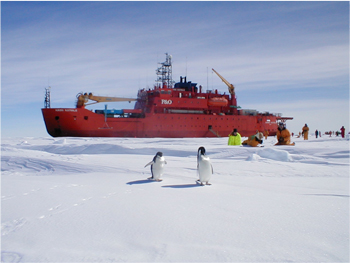 For the first time detailed mercury (Hg) speciation was determined along an Australia-Antarctic section (Cossa, et al., 2011) and cadmium (Cd) isotopes along a South Africa-Antarctic section (Abouchami W., et al., 2011). Both were acquired along two IPY-GEOTRACES sections: SR3 CASO-GEOTRACES (GIPY6) and ZERO&DRAKE (GIPY5) respectively.
Hg species distribution suggests distinct features in the Southern ocean Hg cycle: (i) a net atmospheric Hg deposition on surface water near the ice edge, (ii) Hg enrichment in brines during sea-ice formation and (iii) a methylmercury maximum close to Antarctica, far from anthropogenic Hg emissions (Figure 1).
Cd isotope ratios and concentrations are distributed into two distinct Cd isoscapes, delimiting two biogeochemical provinces the Antarctic Circumpolar Current (ACC) and Weddell Gyre (Figure 2). A doubling of the isotope effect due to biological consumption of Cd is observed during water transport from the Weddell Sea into the ACC. The increase in the magnitude of Cd isotope fractionation, as a result of enhanced phytoplankton biomass and altered species composition in the Southern Ocean, demonstrates that Cd isotopes could potentially serve as a useful measure of biological productivity.
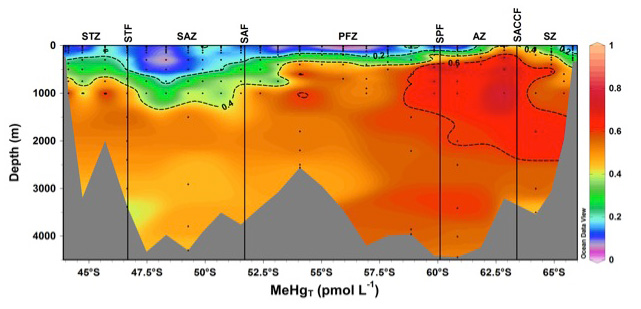
Figure 1. Methylated mercury species (MeHgT) distribution along the SR3 CASO–GEOTRACES transect in the Southern Ocean. Source: Author’s manuscript, definitive authenticated version published in “Geochimica et Cosmochimica Acta“.
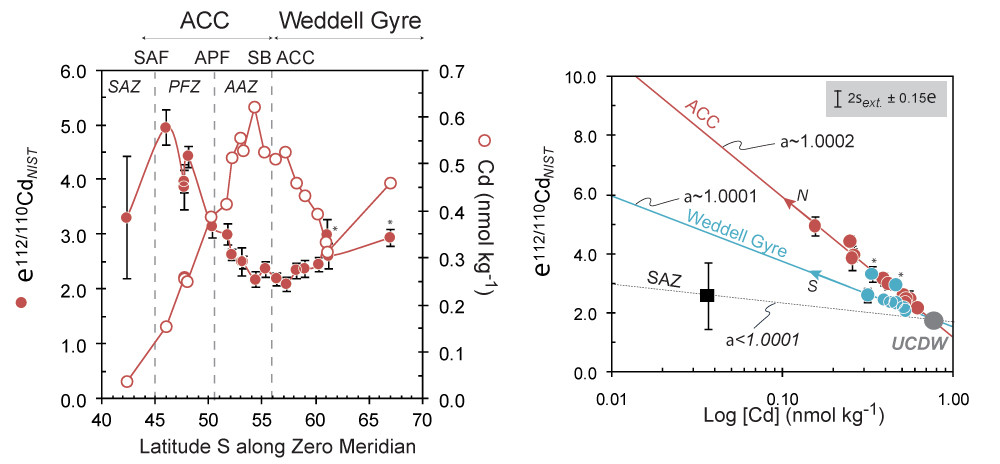
Figure 2. (Left) Latitudinal variations in seawater Cd isotope composition, expressed as ε112/ 110Cd (solid symbol) and Cd concentration (open symbol) along Zero Meridian. (Right) Co-variations between ε112/110Cd and [Cd] (nmol kg−1) in Southern Ocean surface waters. Source: Earth and Planetary Science Letters
References:
Abouchami W., Galer S.J.G., de Baar H.J.W., et al. (2011), Modulation of the Southern Ocean cadmium isotope signature by ocean circulation and primary productivity, Earth and Planetary Science Letters, 305(1-2) DOI: 10.1016/j.epsl.2011.02.044
Cossa, D., Heimbürger, L.-E., Lannuzel, D., Rintoul, S.R., Butler, E.C.V., Bowie, A.R., Averty, B., Watson, R.J., Remenyi, T., (2011), Mercury in the Southern Ocean, Geochimica et Cosmochimica Acta, 75(14): 4037-4052 DOI: 10.1016/j.gca.2011.05.001