
Thanks to GEOTRACES-IPY, more and more iron data in the Arctic
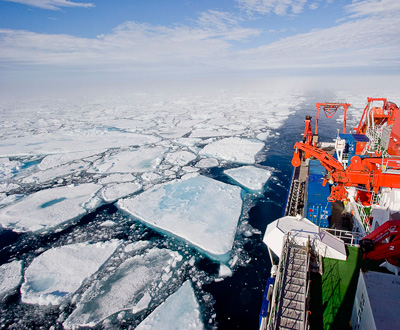
fred_MG_0762_gel2

Klunder, M. B., Bauch D., Laan P., de Baar H.J.W., van Heuven S., and Ober S. (2012), Dissolved iron in the Arctic shelf seas and surface waters of the central Arctic Ocean: Impact of Arctic river water and ice-melt, J. Geophys. Res., 117, C01027, doi:10.1029/2011JC007133.


Dissolved and Total Dissolvable iron (Fe), together with aluminium (Al), seawater δ18O and other ancillary parameters were acquired in the framework of the GEOTRACES-IPY (GPY11) ARK XXII/2 cruise onboard R/V Polarstern in 2007. The roles of fresh water sources (Eurasian river discharges), sea ice, biological uptake/remineralisation and potential release of iron from the shelf sediments on the distribution of iron in the Arctic waters are discussed. This work also advances some hypotheses perspectives concerning biogeochemical cycles in the ocean under the pressure of global change.

Latest highlights

Authigenic radiogenic neodymium isotope composition traces millennial-scale overturning circulation variability in the Arabian Sea

The neodymium isotopic signature of the sediment authigenic fraction is, a priori, a valuable proxy for reconstructing deep-water mass trajectories…

Magmatic activity at the Carlsberg Ridge in the Indian Ocean triggered by glacial sea-level variation

De and colleagues provide a high-resolution record of magmatic input and associated hydrothermal activity over the past 49 kyr from a core recovered from a magmatic segment of the slow-spreading Carlsberg Ridge in the Indian Ocean.

Zinc and lead isotopes reveal human footprint on the most remote oceanic regions

Benaltabet and co-workers analysed suspended particles collected on GEOTRACES GP21 cruise tracked from Chile to New Caledonia.

Organic binding site heterogeneity controls amorphous ferric oxy-hydroxides oceanic sink

In oxygenated seawater iron binds to hydroxide ions, which results in authigenic Fe precipitation as amorphous ferric oxy-hydroxide…

Rechercher