
About the decoupled fates of aluminium, manganese, cobalt and lead in the North Pacific Ocean
Did you know that each of these tracers could follow its own marine story, quite decoupled from the others?
This is what is shown and discussed by Zheng and co-workers (2019, see reference below) after having analysed about 500 samples for aluminium (Al), manganese (Mn), lead (Pb) and cobalt (Co) along three sections in the North Pacific Ocean. They demonstrate that the distribution of each element is uniquely related to ocean circulation; that the subsurface Pb maximum has been sustained in the North Pacific Ocean through the growth of anthropogenic sources in Asia and Russia, contrasting with the decrease observed in the Atlantic Ocean (please also read the science highlight from Bridgestock et al., 2016); that the labile fraction of particulate Al is larger than that of particulate lead; and finally that while the Pb enrichment factor confirms its predominant atmospheric origin, those of Mn and Co clearly attest that sources other than the aerosol deposition are more significant contributors to the concentrations of these two tracers.
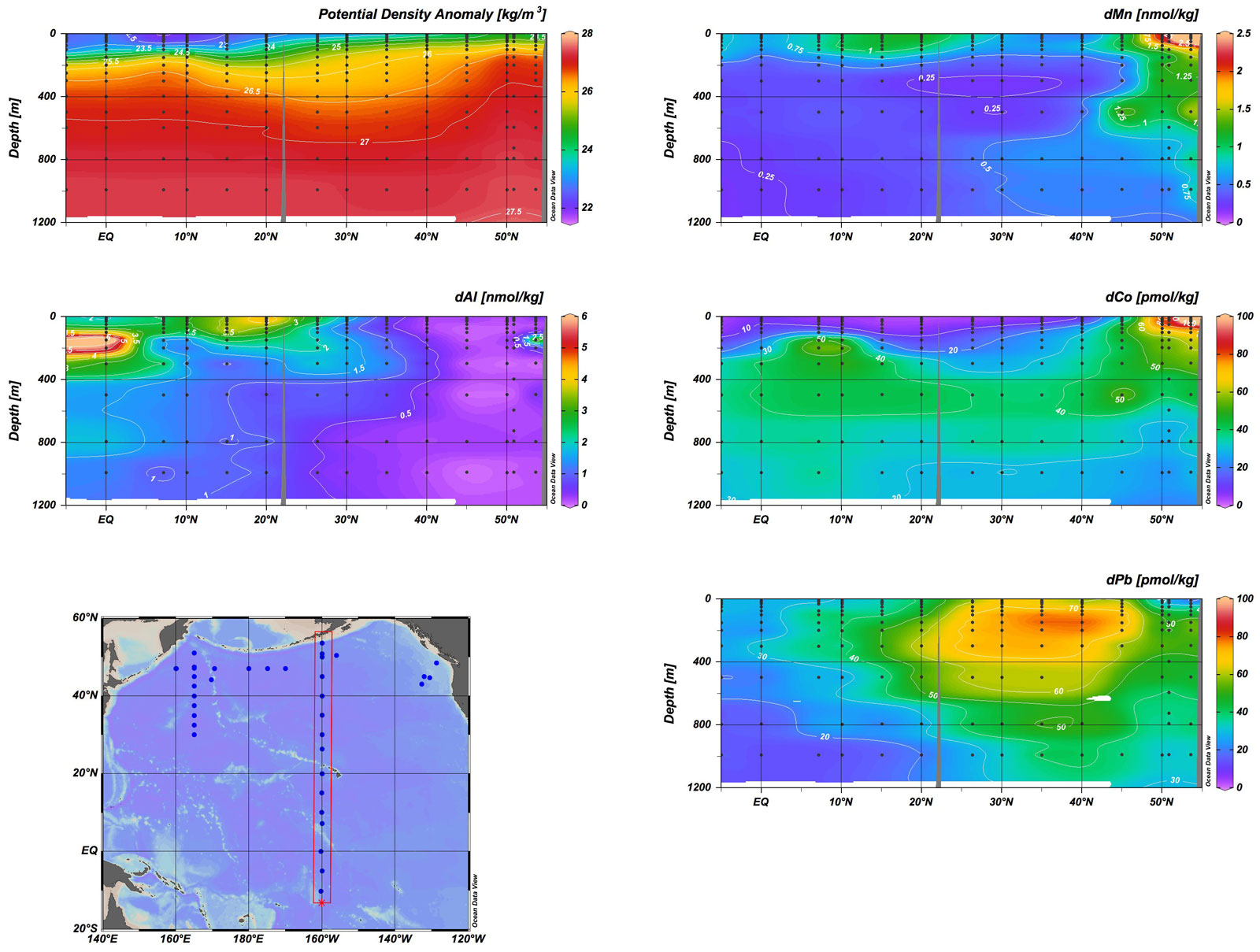
Figure: Sectional distributions of dissolved metals (dM) and potential density anomaly at depths of 0–1200 m along 160°W (section highlighted in red in the map). Dissolved aluminium (dAl) is high in Equatorial Under Current (EQ, 175 m depth) and North Equatorial Current (20°N, surface). Although dissolved manganese (dMn) and dissolved cobalt (dCo) have a concurrent source at the continental shelf of the Aleutian Islands, dCo is more widely distributed via North Pacific Intermediate Water (NPIW, ~600 m). Dissolved lead (dPb) is concentrated in Subtropical Mode Water and Central Mode Water above the NPIW. Adapted from Zheng et al., 2019. Click here to view the figure larger.
Reference:
Zheng, L., Minami, T., Konagaya, W., Chan, C.-Y., Tsujisaka, M., Takano, S., Norisuye, K., Sohrin, Y. (2019). Distinct basin-scale-distributions of aluminum, manganese, cobalt, and lead in the North Pacific Ocean. Geochimica et Cosmochimica Acta, 254, 102–121. DOI: http://doi.org/10.1016/J.GCA.2019.03.038
Bridgestock, L., van de Flierdt, T., Rehkämper, M., Paul, M., Middag, R., Milne, A., Lohan, M.C., Baker, A.R., Chance, R.,, Khondoker, R., Strekopytov, S., Humphreys-Williams, E., Achterberg, E.P., Rijkenberg, M.J.A., Gerringa, L. J.A., de Baar, H. J. W. (2016). Return of naturally sourced Pb to Atlantic surface waters. Nature Communications, 7, 12921. doi: http://doi.org/10.1038/ncomms12921