
The Scottish shelf break is not a significant source of iron to North Atlantic surface waters
A high resolution survey of the distribution of dissolved iron (dFe) over the Hebridean (Scottish) shelf break was conducted as part of the U.K. Shelf Sea Biogeochemistry programme, a GEOTRACES process study (GApr04). Despite the close proximity to shelf sediments, which are known to supply large quantities of dFe to overlying water column, the results revealed surprisingly low concentrations of dFe (<0.1 nM) in surface waters overlying the shelf break. Birchill and colleagues (2019, see reference below) relate this to the prevailing physical circulation of the region, which limits off shelf transport in surface waters, and conclude that this shelf system is not a significant source dFe to high latitude North Atlantic surface waters. It is therefore suggested that the conditions leading to seasonal iron limitation of phytoplankton in the Iceland and Irminger basins extend much further eastwards than previously identified.
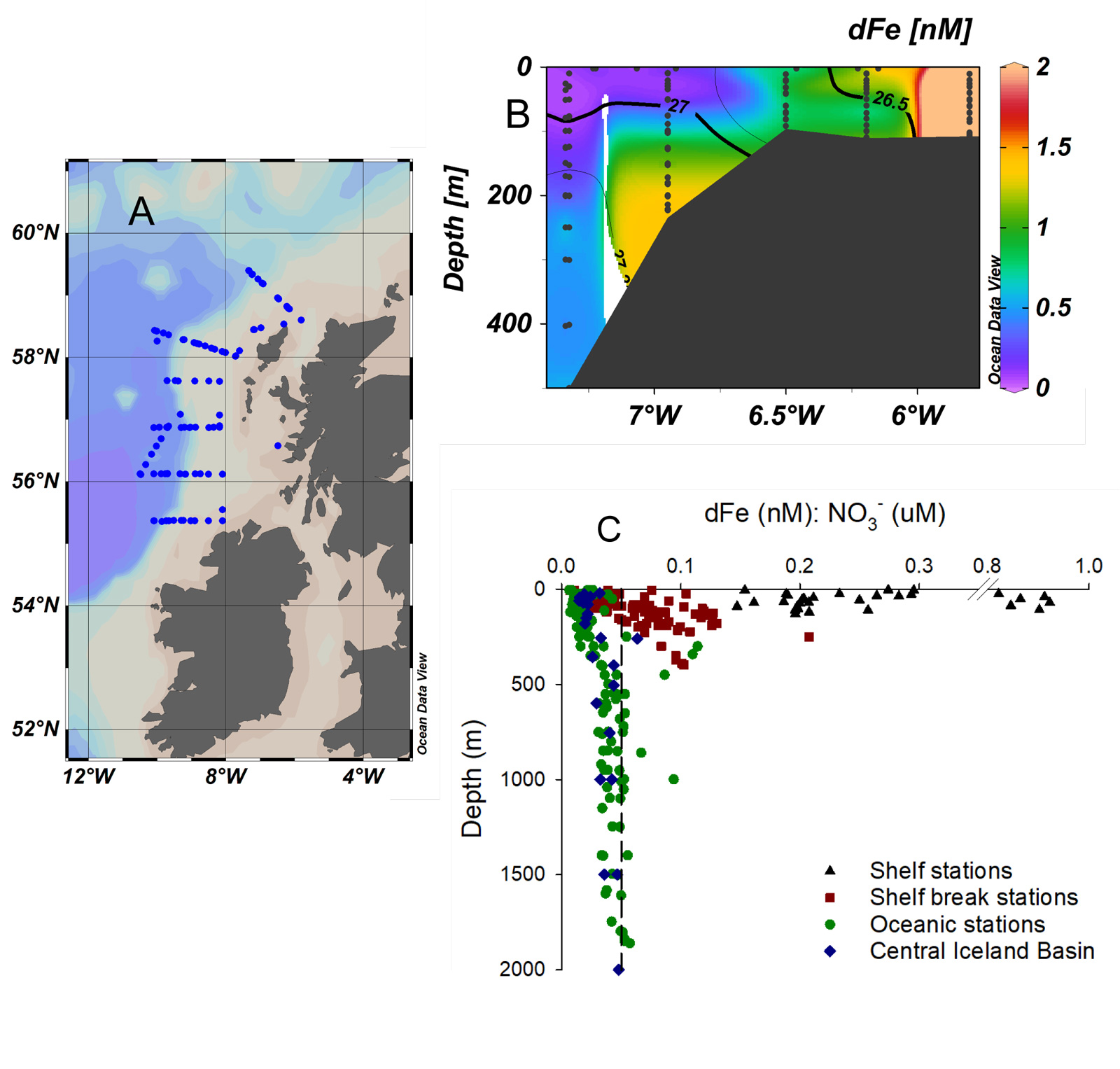
Figure: (A) Map of the survey region with sampling locations. (B) Example of cross shelf transect of dFe distribution, detailing the contrast between shelf waters with high dFe concentrations (>2 nM) and surface oceanic waters with remarkably low dFe concentrations (<0.1 nM). (C) Depth profile of dFe: NO3–, oceanic stations close to Hebridean shelf have similar values to those previously reported for the seasonally iron limited Icelandic Basin. Dashed line denotes 0.05 dFe:NO3− (nM:μM), the lower limit observed in Fe replete cultured phytoplankton. Click here to view the figure larger.
Reference:
Birchill, A. J., Hartner, N. T., Kunde, K., Siemering, B., Daniels, C., González-Santana, D., Milne, A. Ussher, S. J., Worsfold, P. J., Leopold, K., Painter, S. C., Lohan, M. C. (2019). The eastern extent of seasonal iron limitation in the high latitude North Atlantic Ocean. Scientific Reports, 9(1), 1435. DOI: http://doi.org/10.1038/s41598-018-37436-3