
From Alaska to Tahiti, the distribution and bulk deposition fluxes of trace elements
Assessing trace element (TE) atmospheric deposition fluxes is a complicated task, since it requires both the determination of aerosol concentrations and an estimate of the deposition velocity. This coupled approach was conducted by Marsay and collaborators (2022, see reference below) during the U.S. GEOTRACES GP15 Pacific Meridional Transect between Alaska and Tahiti (September—November 2018). A suite of TEs (Al, Ti, V, Cr, Mn, Fe, Co, Ni, Cu, Zn, and Pb) was measured in aerosols collected in the North and equatorial Pacific. Concomitantly, bulk deposition velocity was calculated using the surface ocean decay inventory of the naturally occurring radionuclide, beryllium-7 (7Be), and aerosol 7Be activity.
Even though these samples were collected during the seasonal minimum for outbreaks of Asian dust across the North Pacific, the authors could detect north-south TE concentration gradients. Not surprisingly, aerosol TE concentrations were among the lowest measured during GEOTRACES sections, particularly for elements mostly associated with crustal material. Higher (4,570 ± 1,146 m/d) bulk deposition velocities were observed within the Intertropical Convergence Zone than elsewhere (1,764 ± 261 m/d) due to aerosol scavenging by intense rainfall. TE enrichment factors were higher in the equatorial Pacific than in the North Pacific, due primarily to lower mineral aerosol concentration over the former, except for Vanadium (V), which might trace oil fuel combustion inputs from Asian origin. Finally, the authors propose an estimate of iron (Fe) fluxes ranging from 19 to 258 nmol/m2/d over the whole section.
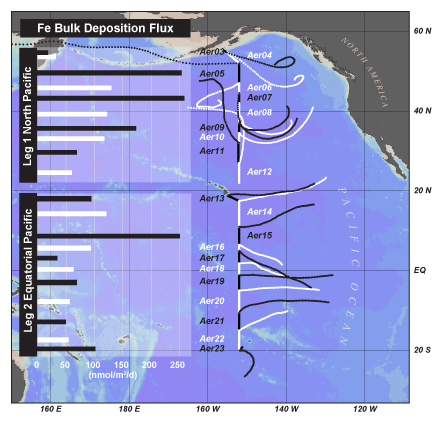
Figure: Map of the GP15 transect with aerosol sampling represented by black (odd number deployments) and white (even deployments) lines spanning between sample deployment and recovery positions. Also shown are 3-day back-trajectories for air masses reaching the start point of each aerosol deployment, and bulk deposition fluxes of Fe for each deployment, based on aerosol Fe concentrations and deposition velocities from 7Be measurements.
Reference:
Marsay, C. M., Kadko, D., Landing, W. M., & Buck, C. S. (2022). Bulk aerosol trace element concentrations and deposition fluxes during the US GEOTRACES GP15 Pacific Meridional Transect. Global Biogeochemical Cycles. doi:10.1029/2021gb007122