
Dust deposition rates extracted from a data-assimilation model of the aluminium oceanic cycle
Using dissolved aluminium (Al) data measured along 11 sections and extracted from the GEOTRACES intermediate data product (IDP2017), Xu and Weber (2021, see reference below) developed a data-assimilation model of the Al oceanic cycle. This model considers all the processes that might affect the oceanic Al distribution, i.e.: advection, diffusion, deposition of soluble Al from dust, hydrothermal sources, adsorption, desorption, uptake by diatoms, remineralization after diatom dissolution and resuspension from seafloor sediment. Model parameters are optimized and twelve dust distributions from atmospheric models are tested to determine the patterns and rates of Al deposition that are most consistent with the GEOTRACES sections, while a range of circulation configurations are used to propagate uncertainty.
Ultimately, the authors determined that 37.2 +/- 11 Gmol of Al must be annually added to the ocean to reproduce the data, with the Atlantic receiving significantly more soluble Al than the Indian or Pacific Oceans. Using the soluble iron:aluminium (Fe:Al) ratio observed in dust, rates of aeolian iron input to the ocean are also estimated. Globally it falls between 2.3 and 9.1 Gmol/yr, but mostly falls short of the biological Fe demand through much of the ocean.
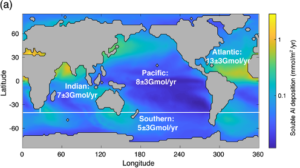
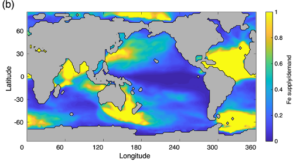
Figure: (a) Soluble Al deposition (mmol/m2/yr) averaged across 60 optimized model configurations, weighted by their skill at reproducing GEOTRACES Al section data. Basin-integrated rates and uncertainty ranges are annotated. (b) Ratio of estimated Fe supply from dust to the Fe demand of upper ocean phytoplankton communities (estimated from satellite-derived C export and an assumed Fe:C uptake ratio). Values lower than 1 indicate that dust cannot meet the entire biological Fe demand.
Reference:
Xu, H., & Weber, T. (2021). Ocean Dust Deposition Rates Constrained in a Data‐Assimilation Model of the Marine Aluminum Cycle. Global Biogeochemical Cycles, 35(9). doi: 10.1029/2021gb007049