
Contrasting fates of the cadmium-cadmium isotopes in the Kuroshio and Oyashio environmental systems
Yang et al. (2018, see reference below) studied the relative importance of physical and biogeochemical processes on controlling the isotopic composition of dissolved and particulate cadmium (Cd) in a GP18 transect, crossing over the relatively cold and eutrophic Oyashio Extension region and the relatively warm and oligotrophic Kuroshio Extension region. Particulate samples revealed preferential uptake of light Cd isotopes by the biological activity. However, the fractionation effect varied dramatically in the surface water of the two regions, larger fractionation factors being observed in the Oyashio Extension region. The cycling in the Kuroshio Extension region was found to follow a closed system fractionation model, whilst the cycling of the Oyashio Extension region fits a steady-state open system fractionation model better. The findings are consistent with the hydrographic contrast in the two regions. In terms of the deep water, physical mixing controls the variations of dissolved Cd concentrations and isotopic composition.
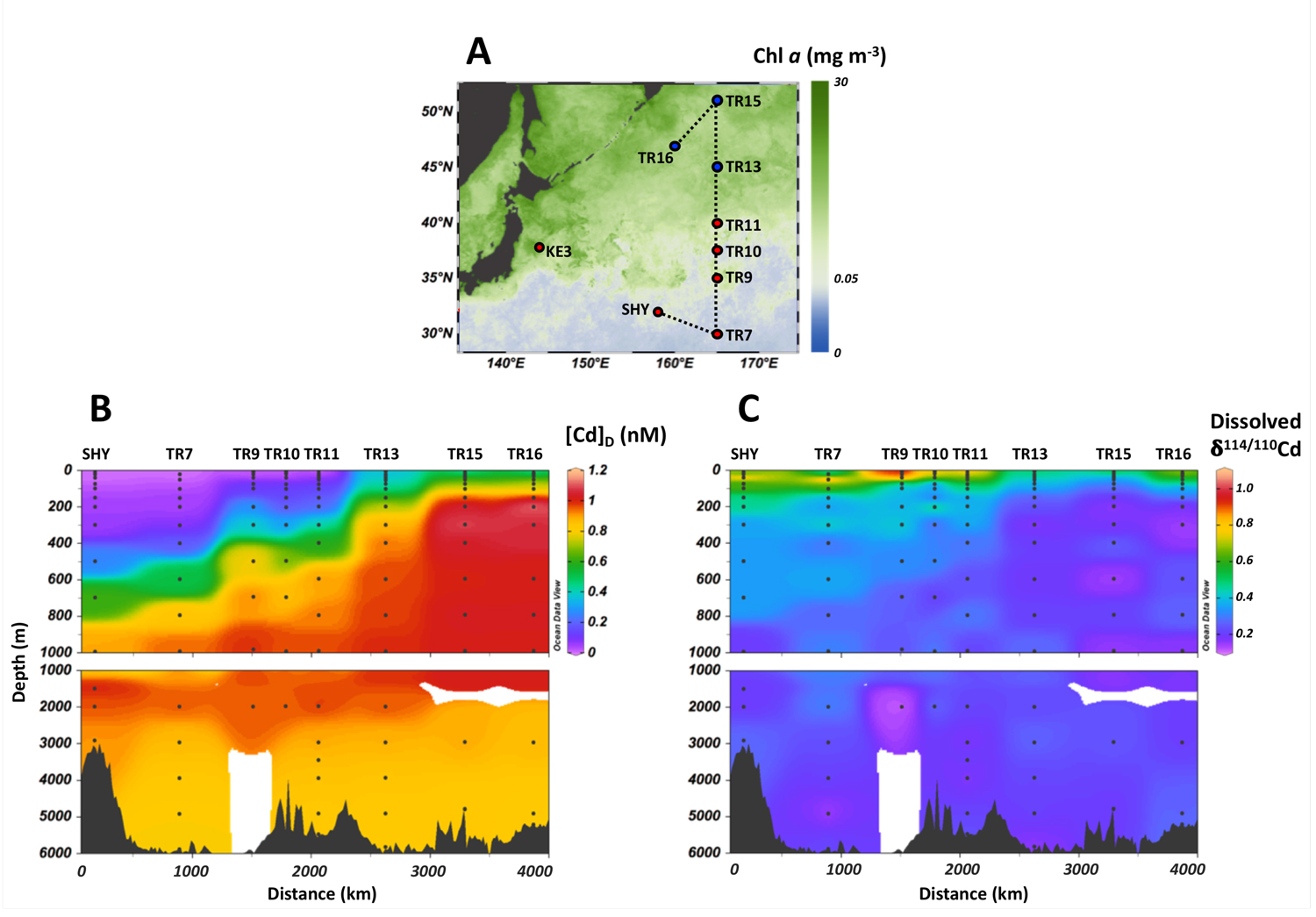
Figure: Locations of sampling stations and averaged chlorophyll a concentrations in 2011. Stations TR13, TR15 and TR16 are located in Oyashio extension region, whereas the other stations are located in Kuroshio extension region. Fig. B and C: Transects of dissolved Cd concentrations and isotopic composition of the studied region, showing comparable distribution in the deep water and contrasting vertical gradient in the thermocline and surface water among Kuroshio and Oyashio stations. Click here to view the figure larger.
Reference:
Yang, S.-C. C., Zhang, J., Sohrin, Y., & Ho, T.-Y. Y. (2018). Cadmium cycling in the water column of the Kuroshio-Oyashio Extension region: Insights from dissolved and particulate isotopic composition. Geochimica et Cosmochimica Acta, 233, 66–80. http://doi.org/10.1016/j.gca.2018.05.001