Climate change induced spectacular increase of the land-ocean inputs in the Arctic Ocean
Measurements of radium-228 (228Ra) in the framework of the 2015 U.S. GEOTRACES Arctic Transect (GN01), revealed that the surface water content of this tracer has almost doubled over the last decade, specifically in the Transpolar Drift near the North Pole.
Radium isotopes are excellent tracers of land-ocean inputs. A mass balance model for 228Ra allowed Kipp and co-workers (2018, see reference below) to suggest that this increase is due to an intensification of shelf-derived material inputs to the central basin. These coastal changes, in turn, could also be delivering more nutrients, carbon, and other chemicals into the Arctic Ocean and lead to dramatic impacts on Arctic food webs and animal populations.
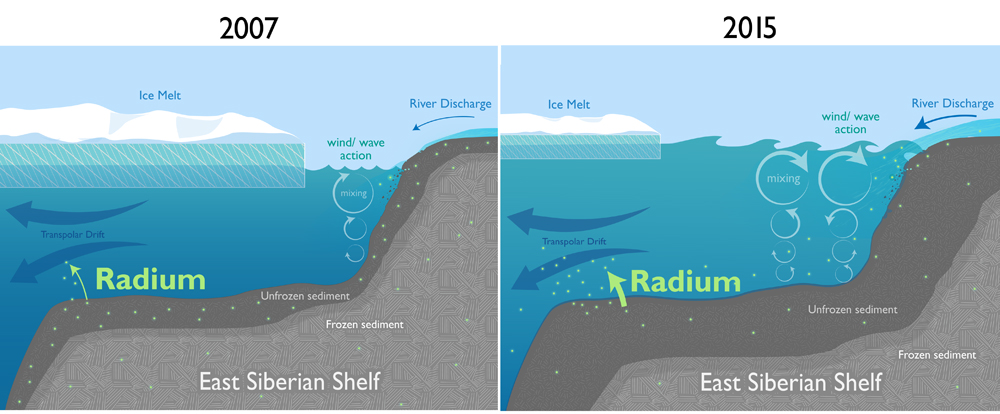
Figure: Diminishing sea ice near the Arctic coast leaves more open water near the coast for winds to create waves. The increased wave action reaches down and stirs up sediments on shallow continental shelves, releasing radium and other chemicals that are carried up to the surface and swept away into the open ocean by currents such as the Transpolar Drift. Artwork: Natalie Renier, Woods Hole Oceanographic Institution. Please click here to view the figure larger.
Reference:
Kipp, L. E., Charette, M. A., Moore, W. S., Henderson, P. B., & Rigor, I. G. (2018). Increased fluxes of shelf-derived materials to the central Arctic Ocean. Science Advances, 4(1), eaao1302. DOI: http://doi.org/10.1126/sciadv.aao1302