
Short-Term Variability of Dissolved Rare Earth Elements and Neodymium Isotopes in the Entire Water Column of the Panama Basin
Patricia Grasse and co-workers (2017, see reference below) present new dissolved neodymium isotope compositions (εNd) and rare earth element (REE) concentrations from the Panama Basin.
REE concentrations peak at the surface reflect high lithogenic inputs from the nearby Central American Arc (CAA) resulting in highly radiogenic εNd signatures, with the observation of the most radiogenic value measured for seawater to date (+4.3). Intermediate and deep waters of the Panama Basin (mean εNd value = 0) are significantly more radiogenic than the inflowing water masses from the Peruvian Basin (−1.1 to −6.6 εNd). This demonstrates that the highly radiogenic Nd isotope compositions must result from release of radiogenic Nd through partial dissolution of volcanic material of the CAA. The re-occupation of one station demonstrates that the high amounts of radiogenic Nd released from these particles can reset water mass Nd isotope and REE signatures of the entire Panama Basin water column within 3.5 years, clearly an area where water masses acquire their signatures before they are advected to the open ocean.
Large amounts of REEs readily released from volcanic particles on such short time scales may require a different parameterization of the Nd isotope signal acquisition processes of water masses in models of the oceanic Nd isotope distribution and are important for the seawater Nd budget.
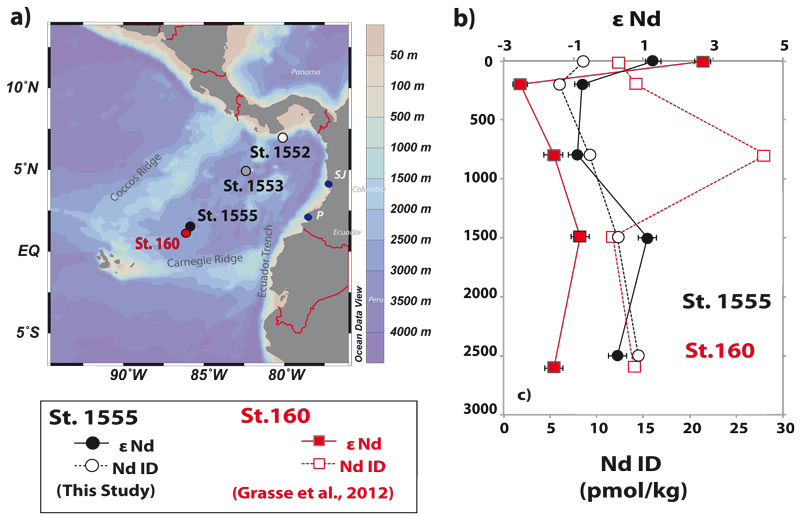
Figure: (a) Map of sampling locations during Meteor Cruise M90 (Oct./Nov. 2012) in the Panama Basin together with the location of re-occupied station 160 sampled previously during Cruise M77-4 in February 2009. The dashed grey line indicates the approximate position of the Intertropical Convergence Zone (ITCZ) in spring and late summer (b) Water column distribution of St. 1555 eNd (filled black circles) and Nd concentrations (open black circles) together with previously occupied St.160 eNd (filled red squares) and Nd concentrations (open red squares) (Grasse et al., 2012). Please click here to view the figure larger.
Reference:
Grasse, P., Bosse, L., Hathorne, E. C., Böning, P., Pahnke, K., & Frank, M. (2017). Short-term variability of dissolved rare earth elements and neodymium isotopes in the entire water column of the Panama Basin. Earth and Planetary Science Letters, 475, 242–253. DOI: 10.1016/j.epsl.2017.07.022