
Manganese in the west Atlantic Ocean in the context of the first global ocean circulation model of manganese
Marco van Hulten and co-workers (2017, see reference below) ran a global ocean model to understand manganese (Mn), a biologically essential element. The model shows that:
(i) in the deep ocean, dissolved [Mn] is mostly homogeneous ~0.10—0.15 nM. The model reproduces this with a threshold on MnO₂ of 25 pM, suggesting a minimal particle concentration is needed before aggregation and removal become efficient.
(ii) The observed distinct hydrothermal signals are produced by assuming both a strong source and a strong removal of Mn near hydrothermal vent.
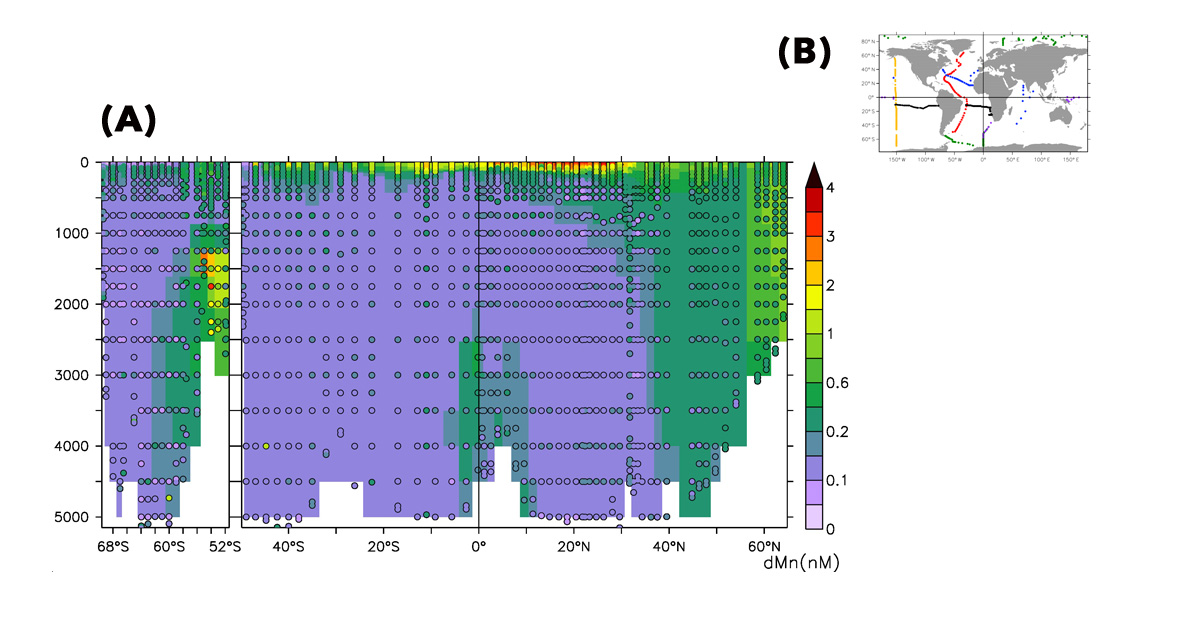 Figure: (A) The modelled dissolved [Mn] (nM) at the Zero-Meridian section component of the GIPY5 cruise dataset, and the West Atlantic GA02 GEOTRACES section cruise (annual average). Observations at the transects are presented as coloured dots. (B) Worldmap showing cruise transects for GA02 (red) and GIPY5 (green, in the Atlantic sector of the Southern Ocean). Please click here to view the figure larger. Modified from Biogeosciences.
Reference:
van Hulten, M., Middag, R., Dutay, J.-C., de Baar, H., Roy-Barman, M., Gehlen, M., Tagliabue, A., and Sterl, A. (2017) Manganese in the west Atlantic Ocean in the context of the first global ocean circulation model of manganese, Biogeosciences, 14, 1123-1152. DOI: 10.5194/bg-14-1123-2017.