
Retreat of large marine-terminating glaciers may increase iron supply to surface waters
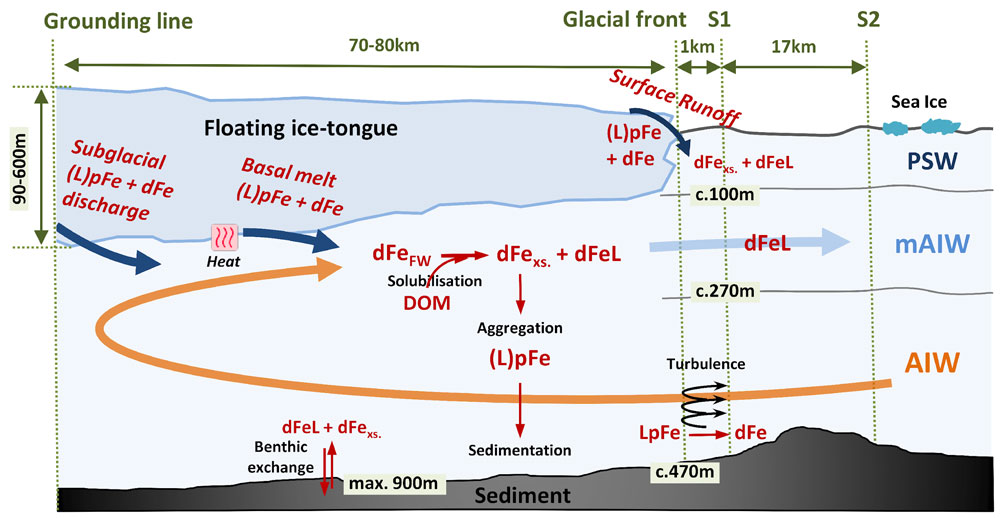
The availability of the micronutrient iron (Fe) limits primary production in large parts of the high latitude oceans. There, glacial discharge enriched in dissolved Fe may stimulate phytoplankton growth and carbon sequestration. Previous research conducted in pro-glacial environments with samples collected on land suggested that glacial dissolved Fe supply to shelf waters may scale with freshwater discharge volume. Yet, data to support this conclusion is lacking for marine-terminating glaciers where glacial freshwater is injected subsurface into subglacial cavity waters residing beneath floating ice-tongues. GEOTRACES expedition GN05 on RV Polarstern sampled immediately adjacent to Greenland’s largest floating ice-tongue. Results reveal that subglacial dissolved Fe discharge from glacier Nioghalvfjerdsbrae at 79°N is decoupled from freshwater Fe inputs, but has important benthic dissolved Fe sources. Krisch et al (2021, see reference below) show that the long residence time of waters inside the subglacial cavity results in equilibration between dissolved Fe, and sedimentary and freshwater Fe sources. As a consequence, dissolved Fe fluxes to the shelf are currently unaffected by increasing freshwater discharge, and may instead scale with the seawater circulation beneath the large floating ice-tongue. The findings demonstrate that glacial retreat and loss of ice-shelves may potentially result in increases in dissolved Fe supply to surface waters downstream of large marine terminating glaciers in future.
Reference:
Krisch, S., Hopwood, M. J., Schaffer, J., Al-Hashem, A., Höfer, J., Rutgers van der Loeff, M. M., Conway, T. M., Summers, B. A., Lodeiro, P., Ardiningsih, I., Steffens, T., Achterberg, E. P. (2021). The 79°N Glacier cavity modulates subglacial iron export to the NE Greenland Shelf. Nature Communications, 12(1), 3030. Access the paper: https://doi.org/10.1038/s41467-021-23093-0