A new method for simultaneous analysis of nickel, copper and zinc isotopes in seawater
Takano and co-workers (2017, see reference below) have developed a new method to determine nickel (Ni), copper (Cu) and zinc (Zn) isotopes in seawater. This method is very simple and rapid only using single chelating extraction and single anion exchange. First, target metals are extracted from seawater by NOBIAS Chelate PA-1 resin. Then, target metals are purified by anion exchange. Finally, isotope ratios are measured by MC-ICPMS. The analyses of GEOTRACES reference samples showed this method is precise and accurate. Vertical profiles of δ60Ni, δ65Cu, and δ66Zn in the South Pacific Ocean were revealed using this method.
This method is expected to accelerate isotopic research and contribute to our understanding of biogeochemical cycling in the ocean.
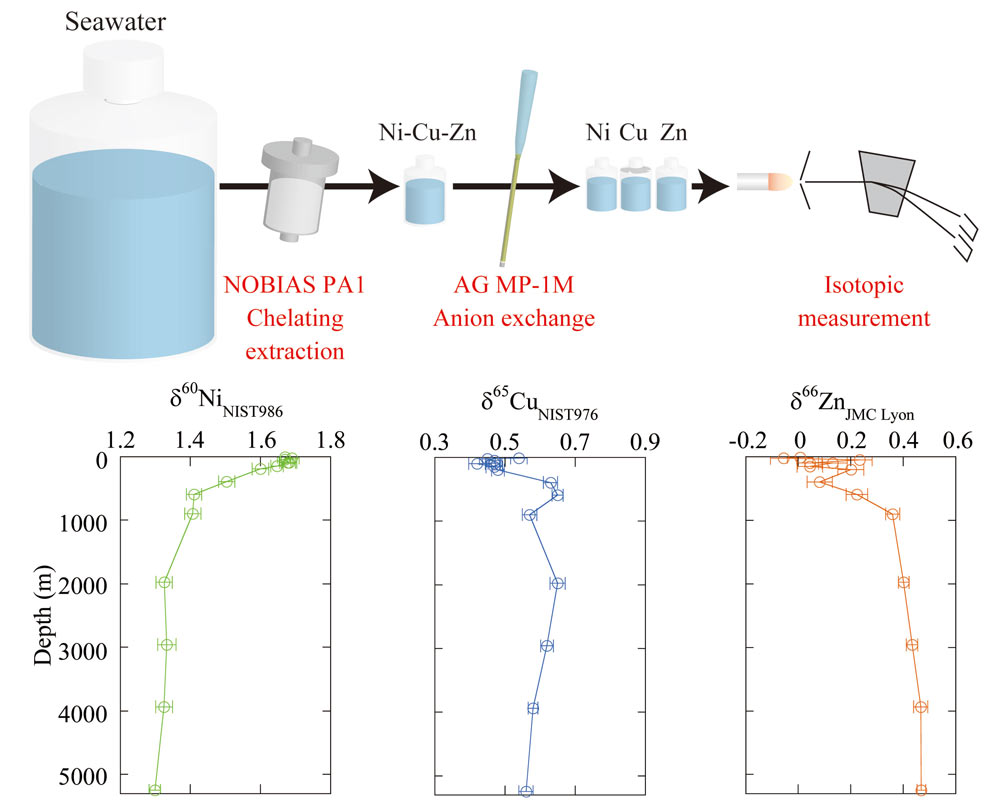
Figure: A schematic diagram of the procedure for isotopic analysis of dissolved Ni, Cu, and Zn in seawater (upper panel). Depth profiles of dissolved δ60Ni, δ65Cu, and δ66Zn at GR15 station (30.00°S, 170.00°W) in the subtropical South Pacific Ocean. The error bars represent 2 standard errors for the MC-ICPMS measurement (lower panel). Click here to view the figure larger.
Reference:
Takano, S., Tanimizu, M., Hirata, T., Shin, K.-C., Fukami, Y., Suzuki, K., & Sohrin, Y. (2017). A simple and rapid method for isotopic analysis of nickel, copper, and zinc in seawater using chelating extraction and anion exchange. Analytica Chimica Acta, 967, 1–11. DOI: 10.1016/j.aca.2017.03.010