
Enlighten why macro and micronutrients display different remineralization length scales
Boyd and co-workers (2017, see reference below) explore the abiotic and biotic mechanisms that underpin internal metal cycling. Although they are focusing on iron (Fe) as the best-characterized metal, they are also discussing zinc (Zn), nickel (Ni) and copper (Cu) behaviors. Based on synchrotron X-ray fluorescence (SXRF) mapping and case studies in different biogeochemical areas of the ocean studied in the framework of GEOTRACES (productive Kerguelen plateau, seasonally oligotrophic subtropical waters, oligotrophic Bermuda and Hawaii waters), they reveal contrasting recycling patterns between trace- and macronutrients, explaining why remineralization length scales differ between elements. They also underline that external supply mechanisms of metals are required to complete their biogeochemical cycles.
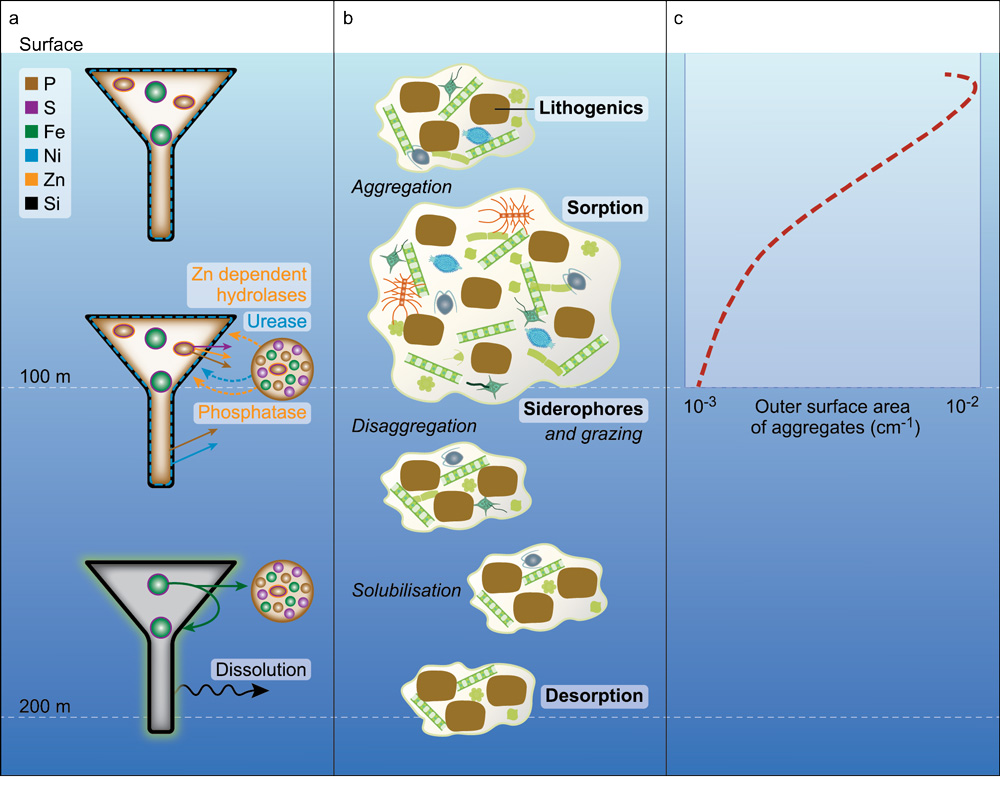 Figure: Processes that set the vertical length scales for the remineralization of elements within sinking particles. a, Hypothetical remineralization mechanisms for trace and major elements associated with a sinking diatom (based on SXRF element mapping). Preferential subsurface regeneration of elements is linked to their association with structural/biochemical cellular components (for example, membranes) and elemental requirements of microbes (circles). b,c, Idealized processes acting on sinking heterogeneous particles (lithogenic/biogenic components with different labilities). Particle transformations drive both remineralization (b, highlighted terms are metal specific) and depth-dependent changes in particle aggregate surface area (c, bio-optical profiling float data, courtesy of George Jackson), which influences local chemistry and microbial processes. Click here to view the figure larger. (Modified from Boyd et al., 2017, Nature Geoscience)
Reference :
Boyd, P. W., Ellwood, M. J., Tagliabue, A., & Twining, B. S. (2017). Biotic and abiotic retention, recycling and remineralization of metals in the ocean. Nature Geoscience, 10(3), 167–173. DOI: 10.1038/ngeo2876