Prokaryotic communities display elevated trace metal concentrations in Pacific oxygen deficient zone
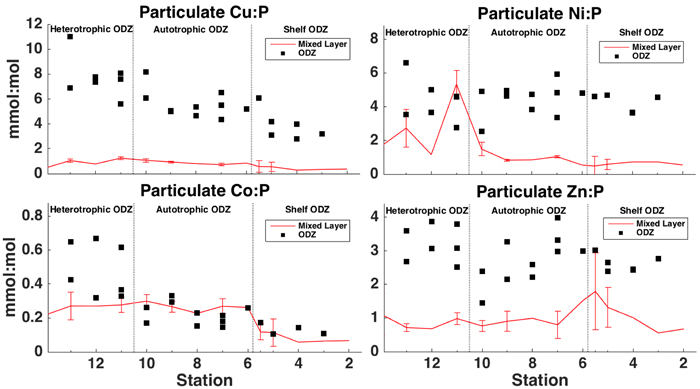
Local particulate maxima in many bioactive trace metals (cadmium, Cd; cobalt, Co; nickel, Ni; vanadium, V; and zinc, Zn) are found in the upper Oxygen Deficient Zone (ODZ), coincident with particulate phosporous (P) maxima that indicate biomass enrichments. This observation was made by Ohnemus and colleagues during the US GEOTRACES Eastern Pacific Zonal Transect (GP16) cruise which crossed the Pacific ODZ and oligotrophic gyre. Their data suggest elevated biotic accumulation of trace metals by ODZ organisms, by factors of 2 to 9 over surface mixed layer communities.
These observations raise many questions regarding the metal requirements and stoichiometric flexibilities of prokaryotes that dominate the ocean interior: Are particulate trace metal (pTM) associations unique to the ODZ? Do they occur because of access to generally larger inventories of dissolved TMs in the subsurface? Which metal enrichments are associated with which organisms? How do elevated–pTM associations in prokaryotic biomass relate to local and global cycling of pTMs throughout the oceans? There is no doubt that these new results open a wide field of research!
Reference:
Ohnemus, D. C., Rauschenberg, S., Cutter, G. A., Fitzsimmons, J. N., Sherrell, R. M. and Twining, B. S. (2016), Elevated trace metal content of prokaryotic communities associated with marine oxygen deficient zones. Limnol. Oceanogr. doi:10.1002/lno.10363