
Aerosol dissolution and iron isotope fractionation during atmospheric transport
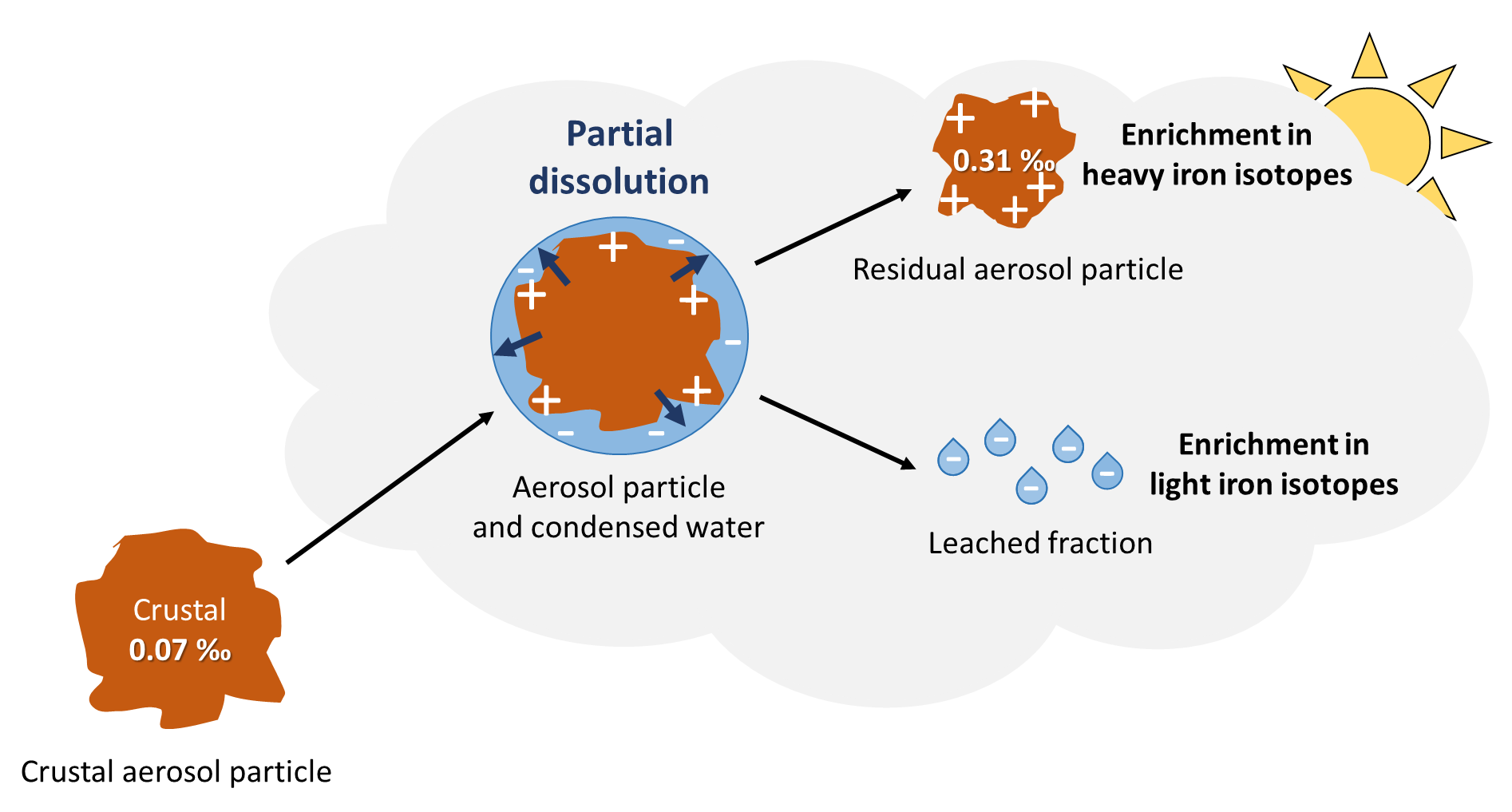
Iron (Fe) limits approximately half of global oceanic primary production. Camin and colleagues (2025, see reference below) present the iron concentrations and isotopic compositions (δ56Fe) of aerosols over the equatorial and tropical Pacific Ocean, in previously undocumented areas. Particulate aerosols larger than 1 μm were sampled during the EUCFe (Equatorial Undercurrent Fe) cruise (RV Kilo Moana, PI: J. W. Murray, 2006). With one exception, all aerosol samples were isotopically heavier than the crust, with a rather homogeneous signature of +0.31 ± 0.21 ‰ (2SD, n=9). Authors suggest that atmospheric processes cause isotopic fractionation of crustal aerosols, leading to these heavy δ56Fe signatures. This can be explained by the preferential dissolution of light Fe isotopes followed by the removal of the dissolved fraction, resulting in the enrichment in heavy isotopes. The observed Fe isotopic signatures require the dissolution and removal of 4 to 20 % – 13 % on average – of the initial aerosol Fe content. While similar fractionation has been observed in laboratory experiments, it has never been documented in aerosols collected in situ. Additionally, the removal of the dissolved fraction has not been previously recorded. This highlights the challenge of using iron isotopes to trace the origin of the aerosols and the unique and strong constrains that iron isotopes bring to atmospheric process studies.
Reference:
Camin, C., Lacan, F., Pradoux, C., Labatut, M., Johansen, A., & Murray, J. W. (2024). Iron isotopes suggest significant aerosol dissolution over the Pacific Ocean. Access the paper: 10.5194/acp-25-8213-2025