
First major ocean sections of silicon isotopes
The GEOTRACES programme is providing the first major ocean sections of silicon isotopes, δ30Si, aiding efforts to use this proxy to reconstruct diatom silica production in both the modern and paleo ocean. In the May, 2015 issue of Global Biogeochemical Cycles Holzer and Brzezinski explore the links between δ30Si within silicic acid and the meriodional overturning circulation using a restoring-type model of the silicon cycle with a data-assimilated, annual mean circulation model. They find the Southern Ocean to be the primary origin of both performed and regenerated δ30Si. The Southern Ocean Si trap sets the light isotopic signature of bottom waters, with heavy isotopes distilled out of the trap through mode water formation. Hydrographic control of δ30Si is important in the Atlantic where the horizontal gradients are dominated by preformed silicic acid. Regenerated silicic acid influences vertical gradients in the Atlantic and the overall δ30Si distributions in other ocean basins.
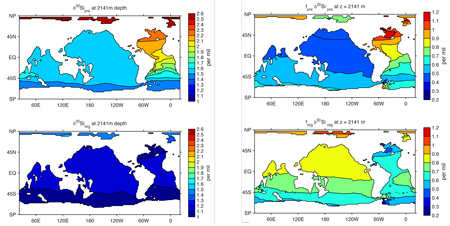
Figure: (Left panels) The isotope ratios, δ30Sipre and δ30Sireg, of the preformed and regenerated Si(OH)4 at ~2000m. (Right Panels) The preformed and regenerated Si(OH)4 fractions, fpre and freg. Note fpre δ30Si pre + freg δ30Sireg reconstructs the observed isotope value δ30Si (not shown). Click here to view the figure larger.
Reference:
Holzer, M., & Brzezinski, M. A. (2015). Controls on the silicon isotope distribution in the ocean: New diagnostics from a data-constrained model. Global Biogeochemical Cycles, 29(3), 267–287. doi:10.1002/2014GB004967. Click here to access the paper.