
Unexpected magnitude of the hydrothermal iron inputs in the deep Pacific
Data from the US GEOTRACES Eastern Pacific Zonal Transect (EPZT, GP16) demonstrate that lateral transport of hydrothermal iron, manganese and aluminium extends up to 4000 km west of the southern East Pacific Ridge, therefore crossing a significant part of the deep Pacific Ocean. The dissolved iron behaves more conservatively than expected, and the resulting flux is more than four times what was assumed before. Results from a coupled ocean circulation/biogeochemical modelling demonstrates that this hydrothermal iron input may sustain a large fraction of the Southern Ocean export production.
Nature decided to largely promote this work by reporting a GEOTRACES 3D view of the bottom Pacific showing the hydrothermal vent as a cover. Congrats to the EPZT team!
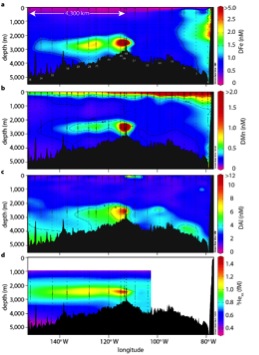
Figure: The top three panels show concentrations of dissolved iron, manganese and aluminum measured during the voyage. The bottom panel shows concentration of a form of helium that marks the water as coming from a hydrothermal vent, and its decreasing concentration away from the ridge reflects mixing rather than a chemical reaction. Click here to view the image larger. Credit: J. Resing / Univ. of Washington.
Reference:
Resing, J. A., Sedwick, P. N., German, C. R., Jenkins, W. J., Moffett, J. W., Sohst, B. M., & Tagliabue, A. (2015). Basin-scale transport of hydrothermal dissolved metals across the South Pacific Ocean. Nature, 523(7559), 200–203. doi:10.1038/nature14577. Please click here to access the paper.