Special End-of-Year GEOTRACES Online Seminar – 15 December, 15:00 CET
Dear colleagues,
We are pleased to announce the Special End-of-Year GEOTRACES Online Seminar, organised by the GEOTRACES Early Career Committee, which will exceptionally take place on 15th December at 15:00 CET.
This seminar will explore the question:
Working backwards: How do we know a paleo-proxy works?
Date/Time: 15th December, 15:00 CET
Speakers: Dr. Tristan Horner (WHOI, USA) and Matthew Jeromson (University of Canberra, Australia)
Moderator: Layla Creac’h (IFREMER – Centre Bretagne, France)
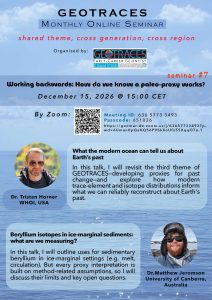
Flyer
By Zoom: https://geomar-de.zoom-x.de/j/63657733493?pwd=6Uman0pQaKQ56P9SkXoUfz55XqqO7a.1
Meeting ID: 636 5773 3493
Passcode: 651026
Further information about the seminar is provided below.
Recordings of previous seminars are available on the GEOTRACES YouTube channel or via the following OneDrive link: 2026OnlineSeminars.
We warmly encourage you to join this seminar!
Best wishes,
GEOTRACES IPO
Special end-of-year seminar:
Date/Time: 15th December, 15:00 CET
Topic: Working backwards: How do we know a paleo-proxy works?
Moderator: Layla Creac’h (IFREMER – Centre Bretagne, France)
Detailed description:
Talk 1: What the modern ocean can tell us about Earth’s past
Dr. Tristan Horner (Woods Hole Oceanographic Institution, USA)
Abstract: In this talk, I will revisit the third theme of GEOTRACES—developing proxies for past change—and explore how modern trace-element and isotope distributions inform what we can reliably reconstruct about Earth’s past.
Talk 2: Beryllium isotopes in ice-marginal sediments: what are we measuring?
Dr. Matthew Jeromson (University of Canberra, Australia)
Abstract: In this talk, I will outline uses for sedimentary beryllium (Be) in ice-marginal settings (e.g. melt, circulation). But every proxy interpretation is built on method-related assumptions, so I will discuss their limits and key open questions.
For more information and updates, check the seminar web page.