REMINDER: GEOTRACES Online Seminar #7 – 24 November 15:00 CET
Dear colleagues,
This is a kind reminder that the seventh GEOTRACES Online Seminar, organised by the Early-Career Scientist Committee, which will take place on Tuesday, 24 November 2026, from 15:00 to 16:00 CET.
This seminar will focus on:
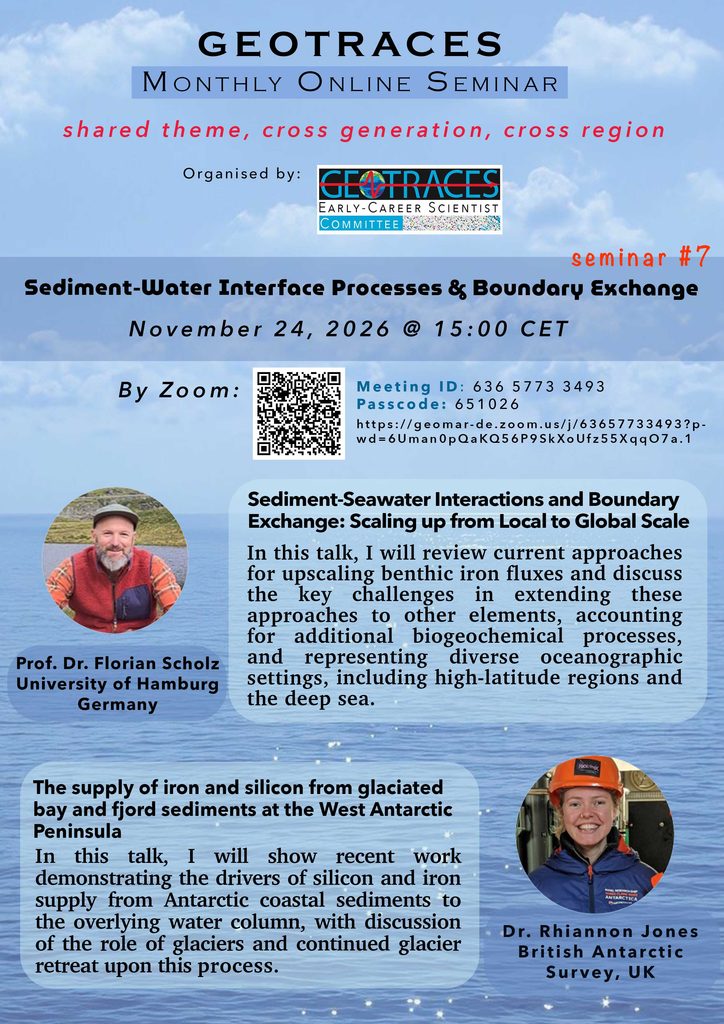
Topic: Sediment-Water Interface Processes & Boundary Exchange
Date/Time: November 24th, 15:00 CET
Moderator: Zhouling Zhang (GEOMAR, Germany)
Flyer
By Zoom: https://geomar-de.zoom-x.de/j/63657733493?pwd=6Uman0pQaKQ56P9SkXoUfz55XqqO7a.1
Meeting ID: 636 5773 3493
Passcode: 651026
As previously announced, the next seminar will be the special end-of-year session on Tuesday, 15 December 2026. Please save the date.
Further information on both seminars is provided below.
Recordings of previous seminars are available on the GEOTRACES YouTube channel or via the following OneDrive link: 2026OnlineSeminars.
We warmly encourage you to join this seminar!
Best wishes,
GEOTRACES IPO
Seminar detailed information:
Topic: Sediment-Water Interface Processes & Boundary Exchange
Date/Time: November 24th, 15:00 CET
Moderator: Zhouling Zhang (GEOMAR, Germany)
Talk 1: Sediment-Seawater Interactions and Boundary Exchange: Scaling up from Local to Global Scale
Prof. Dr. Florian Scholz (University of Hamburg, Germany)
Abstract: Over the past two decades, the GEOTRACES program has revealed the profound influence of seafloor processes on marine trace metal biogeochemical cycles. However, robust approaches for scaling up local benthic fluxes and dynamically incorporating them into global biogeochemical models remain elusive for most elements. In this talk, I will review current approaches for upscaling benthic iron fluxes and discuss the key challenges in extending these approaches to other elements, accounting for additional biogeochemical processes, and representing diverse oceanographic settings, including high-latitude regions and the deep sea.
Talk 2: The supply of iron and silicon from glaciated bay and fjord sediments at the West Antarctic Peninsula
Dr. Rhiannon Jones (British Antarctic Survey, UK)
Abstract: High latitude fjords represent important environments for primary productivity, carbon storage, and the supply of glacier-derived dissolved and particulate metals (iron, manganese, silicon) to the high latitude oceans. Fjord sediments can receive high and variable volumes of lithogenic material from glaciers and sinking biogenic material. The microbially-mediated redox reactions within sediments moderate the reactivity and supply of iron and silicon back to the overlying water column. In this talk, I will show recent work demonstrating the drivers of silicon and iron supply from Antarctic coastal sediments to the overlying water column, with discussion of the role of glaciers and continued glacier retreat upon this process.
Special end-of-year seminar:
Date/Time: December 15th, 15:00 CET
Topic: Working backwards: How do we know a paleo-proxy works?
Moderator: Layla Creac’h (IFREMER – Centre Bretagne, France)
Flyer
Detailed description:
Talk 1: What the modern ocean can tell us about Earth’s past
Dr. Tristan Horner (Woods Hole Oceanographic Institution, USA)
Abstract: In this talk, I will revisit the third theme of GEOTRACES—developing proxies for past change—and explore how modern trace-element and isotope distributions inform what we can reliably reconstruct about Earth’s past.
Talk 2: Beryllium isotopes in ice-marginal sediments: what are we measuring?
Dr. Matthew Jeromson (University of Canberra, Australia)
Abstract: In this talk, I will outline uses for sedimentary beryllium (Be) in ice-marginal settings (e.g. melt, circulation). But every proxy interpretation is built on method-related assumptions, so I will discuss their limits and key open questions.
For more information and updates, check the seminar web page.