GEOTRACES An International Study of Marine Biogeochemical Cycles of Trace Elements and their Isotopes

logo-scor

  • Skip to content
  • Jump to main navigation and login
  • Home
  • About
    • GEOTRACES Mission
    • GEOTRACES Challenges and Benefits
    • GEOTRACES Key Parameters
    • GEOTRACES Themes
    • GEOTRACES Activities
    • GEOTRACES Policies
    • GEOTRACES Structure
    • SSC Members and Officers
    • Funding
    • Related International Programs
  • Science
    • Science Highlights
    • GEOTRACES Science Plan
    • Planning documents
    • Cruise overview
    • Data and Data Management
    • Intercalibration
    • National and Regional Activities
    • BioGEOTRACES
    • Database Expertise Submission Form
  • Cruises
    • Cruise Summary
    • Forthcoming Cruises
    • Completed Cruises
  • Meetings
    • List of Meetings by year
    • GEOTRACES Workshops and Meetings
  • Library
    • Planning Documents
    • Scientific Publications
      • Science Plan
      • Workshop and Planning Reports
      • Cruise Reports
      • Peer-reviewed Papers Database
      • PhD and Master Dissertations
    • GEOTRACES Policies
    • Annual Reports to SCOR
    • Publicity Documents
    • Resources
  • Capacity Building
    • GEOTRACES Capacity Building Activities
  • Outreach
    • GEOTRACES e-Newsletter
    • Publicity Documents
    • GEOTRACES Brochure
    • Cruise Blogs
      • GP13 Cruise Blog
  • Forum
  • News&Jobs
    • News
    • Funding Opportunities
    • Job Opportunities
    • Student Opportunities
    • Cruise Opportunities
  • Contact us

Quick Links

  • Science Highlights
  • GEOTRACES Policies
  • Data and Data Management
  • Standards, Methods & Intercalibration
  • Calendar of Meetings
  • GEOTRACES Brochure
FacebookRSS Feed
GEOTRACES Papers

Welcome to GEOTRACES

Welcome to GEOTRACES

GEOTRACES is an international programme which aims to improve the understanding of biogeochemical cycles and large-scale distribution of trace elements and their isotopes in the marine environment. Scientists from approximately 35 nations have been involved in the programme, which is designed to study all major ocean basins over the next decade.

Stations Completed: 0 0 5 1 6
160513 worldmap low

GEOTRACES Sections. For more information please click here. In red: Planned Sections. In yellow: Completed Sections. In black: Sections completed as GEOTRACES contribution to the IPY. Download the map.

Latest News!
more news...

Substantial intra-basin variation of the dissolved metal/phosphorus ratio in the different water masses of the Indian Ocean

  • Print
  • Email
Details
Published on Thursday, 23 May 2013 14:29

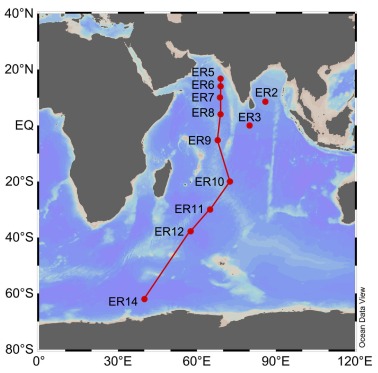
The first simultaneous, full-depth, and basin-scale section-distribution of dissolved (D) Al, Mn, Fe, Co, Ni, Cu, Zn, Cd, and Pb is reported in the Indian Ocean. In addition to widespread co-limitation for phytoplankton production by DFe and occurrence of redox-related processes, the authors observe an important variability of the dissolved metal/phosphorus ratio among the water masses within the Indian ocean (up to a factor of 300 between Arabian Surface waters and Lower Circumpolar Deep Water). The Cu/P, Zn/P, and Cd/P ratios are within the same order of magnitude for both phytoplankton and deep water, whereas the Mn/P, Fe/P, and Co/P ratios of phytoplankton can increase 100-fold or more compared to those in deep water. Such results are questioning the validity of using an "extended Redfield ratio" to trace metals. The consistent mechanism yielding these variations remains to be undersood...

Meridional section distribution (~70°E) of the DMn/DAl ratio Click on the image to view it larger

Figure: Meridional section distribution (~70°E) of the DMn/DAl ratio

Share

Read more...

Neodymium isotopic compositions and rare earth element (REE) data evidence Boundary Exchange in the SW Tropical and Equatorial Pacific.

  • Print
  • Email
Details
Published on Tuesday, 21 May 2013 12:11

New rare earth element concentrations and Nd isotopic compositions measured between the southwestern Tropical and the central equatorial Pacific (112 samples) support the hypothesis that the main process driving the geochemical supply in this area is boundary exchange. Nd signatures confirm the major role of the Papua New Guinea coast but also reveal new candidates such as French Polynesia, Vanuatu, Fiji or Galapagos to explain the progressive geochemical enrichment of the waters along their pathways. The positive europium anomaly characterizing the REE patterns of the water masses also trace these continental inputs.

Grenier 2013

Click on the image to view it larger.

Figure: εNd of the dissolved fraction of the upper (top) and lower (bottom) thermocline water masses flowing in the Southwestern and Equatorial Pacific, identified by red dots on the adjacent θ-S plots. Each dot corresponds to a Nd sample and its color refers to its εNd value. Currents are represented by grey arrows. Large red arrows illustrate areas along the water mass pathways where radiogenic supplies likely occur to explain observed εNd changes. The bathymetry shallower than 250m is colored in brown.

Share

Read more...

Dutch GEOTRACES cruise (GA04-N) is sailing in the Mediterranean and Black Sea

  • Print
  • Email
Details
Published on Tuesday, 14 May 2013 13:25

The RV Pelagia of the Royal Netherlands Institute for Sea Research left the harbor of Lisbon on 14 May with 18 on-board participants to start the first of three legs covering the whole Mediterranean and Black Sea (GA04-N). Together with the MedSeA - GA04-S cruise on the Spanish RV Angeles Alvariño researchers will sample a wide range of parameters including all GEOTRACES core parameters. With the RV Pelagia they will sample 38 stations in the territorial waters of 13 different Mediterranean countries. The first leg will finish in Istanbul on 6 June. The second leg will start on 13 July and covers the Black Sea. The last leg starts 25 July in Istanbul and finishes in Lisbon on 13 August and covers the northern part of the Mediterranean Sea.

The cruise can be followed via the NIOZ website (rightmost column): www.nioz.nl

Chief Scientist: Micha Rijkenberg (Royal Netherlands Institute for Sea Research)

Share

Departure of the GEOTRACES Cruise GA04-S in the Mediterranean Sea

  • Print
  • Email
Details
Published on Thursday, 02 May 2013 18:16

The MedSeA - GA04S cruise departed Cadiz on May 2 on board RV Angeles Alvariño.  It will cover the GA04 section along the Mediterranean Sea, in combination with a NIOZ cruise on board Pelagia (GA04-N). This cruise consists of two legs. The first leg will cover 16 stations in the southern Mediterranean Sea. After the first leg, approximately on May 18, the cruise will enter the harbor of Heraklion (Crete, Greece). The second leg will start on May 19 and cover the northern Mediterranean Sea. 

Follow the actuality of the cruise at: http://medseaoceancruise.wordpress.com/

See the position of the cruise at (page in Spanish): http://www.ieo-santander.net/marinetraffic.html

For futher information about GA04 section cruises please click here.


Share

More Articles...

  1. Report from the SCOR WG139 on Organic Ligands
  2. Examining the Results from the US GEOTRACES North Atlantic Section (GA03)
  3. Goldschmidt 2013 - GEOTRACES Relevant Special Sessions
  4. New GEOTRACES Reports Available!
  5. Soliciting interest for an international intercalibration effort

Login

To get a username and password, please contact the GEOTRACES IPO.

  • Forgot your password?
  • Forgot your username?

Copyright © 2013 GEOTRACES. All Rights Reserved.

This web site is hosted by OBSERVATOIRE OCEANOLOGIQUE DE VILLEFRANCHE SUR MER.